Lin Jifu, a professor at the Chinese Central University for Nationalities, edited in 2016 an eight-volume project named A Collection of Chinese Folk Games. One of those volumes is dedicated to board games. This page shows minimalistic abstract games described in the book, together with automatic translations by LLMs, between December 2025 and January 2026. I include both the book page and the automatic translation, for Chinese speakers to compare. It is also included a short summary of each game, for readers to understand their main themes. This page also includes some entries from Folk Board Games (民间棋类游戏) by Luo Jianjiang (罗鉴江 编著). I wish to thank Mingyang Tian and @Shobu1701 for their support.
Bamboo-Basket Game (筜箕棋)

Bamboo-Basket Game is a two-player abstract strategy game. Its gameplay
is similar to Nine Men’s Morris.

1. Setup

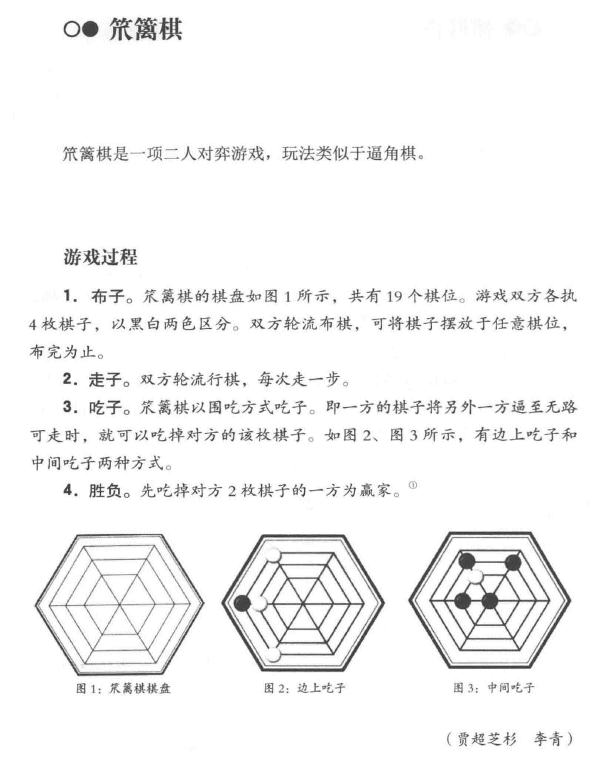
The Bamboo-Basket board is shown in Figure 1. It has a total of 19 points
(positions). Each player has 4 pieces, distinguished by black and white.
Players take turns placing their pieces on any empty points of the board.
The setup phase ends once all pieces have been placed.

2. Movement

After setup, players take turns moving, one move per turn.

3. Capturing

Captures are made by encirclement.

When a player’s pieces surround an opponent’s piece so that it has no path
to escape, that opponent piece may be captured and removed from the board.
As shown in Figures 2 and 3, there are two types of captures: edge capture
and central capture.

4. Winning

The first player to capture 2 of the opponent’s pieces wins the game.

Captions

* Figure 1: Bamboo-Basket board
* Figure 2: Edge capture
* Figure 3: Central capture

Source: Guo Chaoyun, Li Qing)
Chase-and-Evade Game (追随棋)

1. Setup

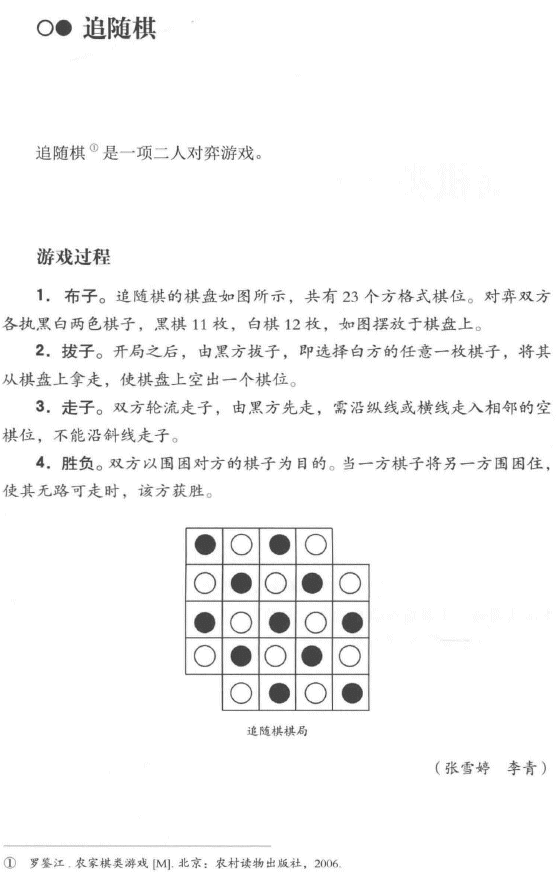
The Chase-and-Evade board is shown in the diagram. It consists of 23 square grid
points. The two players use black and white pieces. Black has 11 pieces, and
White has 12 pieces, which are arranged on the board as shown in the
illustration.

2. Removal (Opening action)

After the game begins, Black moves first. Black selects any one of White’s
pieces and removes it from the board, leaving that point empty.

3. Movement

Players then take turns moving, with Black moving first. A move must follow the
grid lines, either horizontally or vertically, to an adjacent empty point.
Diagonal moves are not allowed.

4. Winning

Both players aim to surround the opponent’s pieces. When one player completely
surrounds the opponent’s pieces so that they have no legal moves, that player
wins.

Figure caption
  Chase-and-Evade starting position

(Source: Zhang Xueqi, Li Qing)
Juhuiqi (聚会棋)

Juhuiqi is a two-player abstract strategy game. Its gameplay is similar to
Dingziqi (peg-connection games).

Game Procedure

1. Setup

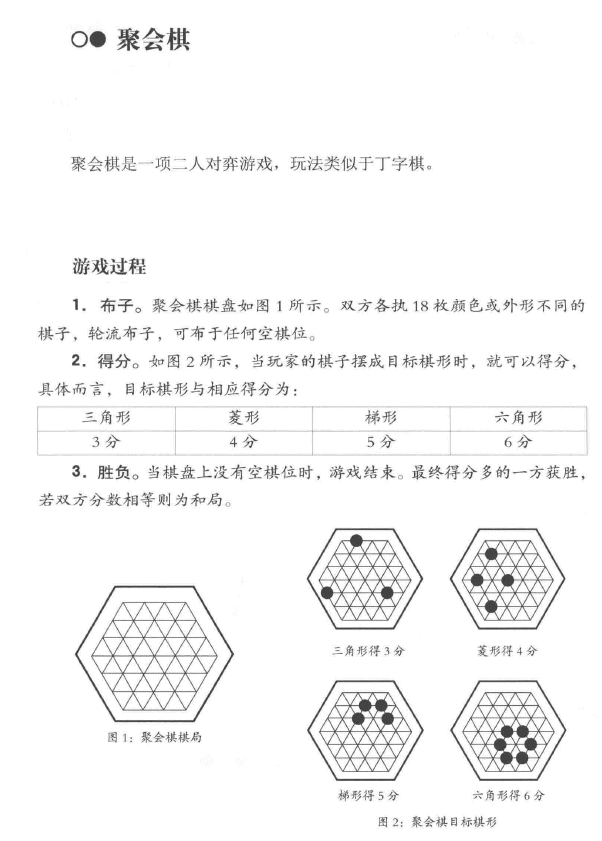
The Juhuiqi board is shown in Figure 1.
Each player has 18 pieces of a distinct color or shape.
Players take turns placing one piece at a time. Pieces may be placed on any
empty position on the board.

2. Scoring

As shown in Figure 2, when a player’s pieces form a target shape, that player
scores points. Specifically, the score awarded for each target shape is as
follows:

    | Target Shape      | Score    |
    | ----------------- | -------- |
    | Triangle          | 3 points |
    | Diamond (rhombus) | 4 points |
    | Trapezoid         | 5 points |
    | Hexagon           | 6 points |

3. End of the Game / Winning
When there are no empty positions left on the board, the game ends.
The player with the higher total score wins.
If both players have the same score, the game is a draw.

---

Figure captions

 Figure 1: Juhuiqi board
 Figure 2: Target shapes in Juhuiqi

   Triangle: scores 3 points
   Diamond: scores 4 points
   Trapezoid: scores 5 points
   Hexagon: scores 6 points
Plum Blossom Chess (梅花棋, Méihuā Qí)

Plum Blossom Chess is a forming-pattern-type confrontational game with
gameplay similar to Gather Chess (聚会棋, Jùhuì Qí). Both sides take
turns placing pieces, with the goal being to form the target pattern
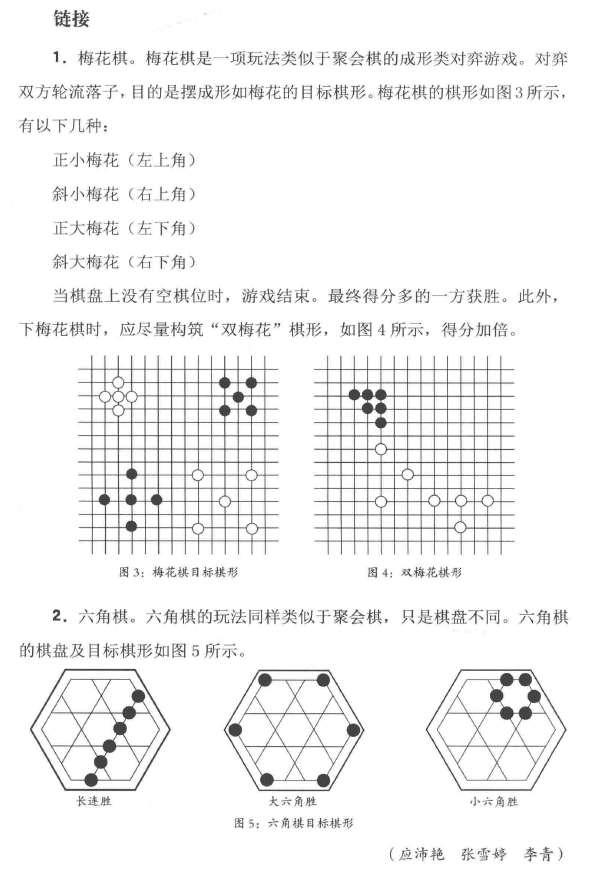
shaped like a plum blossom. The plum blossom patterns are shown in
Figure 3 and include the following types:

    Upright Small Plum Blossom (正小梅花) - (Top Left)

    Slanted Small Plum Blossom (斜小梅花) - (Top Right)

    Upright Large Plum Blossom (正大梅花) - (Bottom Left)

    Slanted Large Plum Blossom (斜大梅花) - (Bottom Right)

The game ends when there are no empty positions left on the board.
The side with the highest final score wins. Additionally, when placing
a plum blossom, one should try to construct the "Double Plum Blossom"
(双梅花) shape, as shown in Figure 4, which doubles the score.

    Figure 3: Plum Blossom Chess Target Patterns (one point each)

    Figure 4: Double Plum Blossom Pattern (two points each)

2. Hexagonal Chess (六角棋, Liùjiǎo Qí)

The gameplay of Hexagonal Chess is also similar to Gather Chess,
but the board is different. The Hexagonal Chess board and target
patterns are shown in Figure 5.

    Long Connected Win (长连胜, Cháng Liánshèng)

    Large Hexagon Win (大六角胜, Dà Liùjiǎo Shèng)

    Small Hexagon Win (小六角胜, Xiǎo Liùjiǎo Shèng)

    Figure 5: Hexagonal Chess Target Patterns

(应沛驰 Zhang Xuefeng Li Qing)
The patterns in the hexagonal version seem impossible to achieve with proper play.
A similar game appears in Folk Board Games (民间棋类游戏) by Luo Jianjiang (罗鉴江 编著) where pieces start along the perimeter (alternating) and slide over lines of empty intersections:
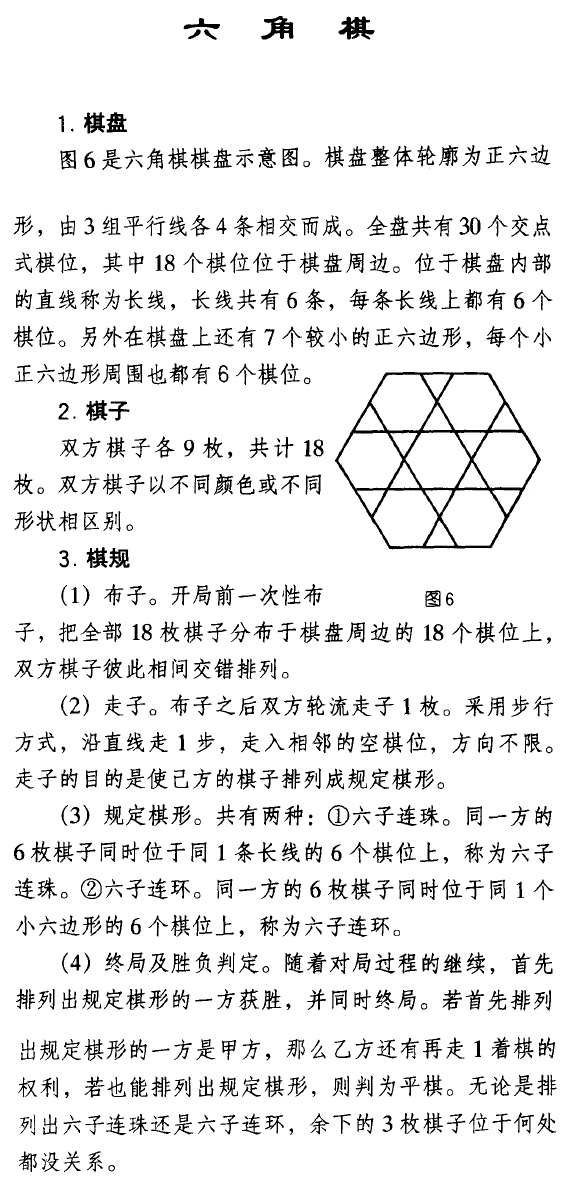
Hexagon Chess (六角棋)

1. The Board

Figure 6 shows the hexagonal chessboard. The overall outline of the board is a
regular hexagon, formed by three sets of four parallel lines intersecting each other.

The board has a total of 30 intersection points that serve as playing positions,
18 of which lie on the perimeter of the board.

The straight lines inside the board are called long lines. There are 6 long lines,
and each long line contains 6 positions. In addition, there are 7 smaller regular
hexagons on the board; the perimeter of each small hexagon also contains 6 positions.

2. Pieces

Each side has 9 pieces, for a total of 18 pieces.
The pieces of the two sides are distinguished by different colors or different shapes.

3. Rules

(1) Placement

Before the game begins, pieces are placed once only.
All 18 pieces are distributed onto the 18 perimeter positions of the board,
with the two sides’ pieces interleaved alternately.

(2) Movement

After placement, the two sides take turns moving one piece per turn.
Movement is step-based: a piece moves one step along a straight line to
an adjacent empty position, with no restriction on direction.

The objective of movement is to arrange one’s own pieces into the specified formation.

(3) Specified Formations

There are two types:

Six-in-a-line (六子连珠)
When six pieces of the same side simultaneously occupy the six positions on
the same long line, this is called six-in-a-line.

Six-in-a-ring (六子连环)
When six pieces of the same side simultaneously occupy the six positions of a
single small hexagon, this is called six-in-a-ring.

(4) End of Game and Victory Conditions

As the game progresses, the side that first forms a specified formation wins
immediately, and the game ends.

If the side that first forms a specified formation is Player A, then Player B
is still entitled to make one final move. If Player B can also form a specified
formation with that move, the result is a draw.

Whether the formation is six-in-a-line or six-in-a-ring, the positions of the
remaining three pieces are irrelevant.
.gif)
.gif)
Liudaoqi (Six-Path Game)

Liudaoqi, also called Dafangqi, Insert-Dafang, or Swing-Dafang, is played
in a way similar to Gobang (Five-in-a-Row). It is a two-player abstract
strategy game that is popular and widely spread among the people.

Game Procedure

1. Setup

The board of Liudaoqi is shown in the diagram: it has 25 intersections
and a total of 36 playing lines. Each player has 33 pieces, which may be
round or of other shapes. Players take turns placing pieces on any empty
intersection except the center point, until the board is completely filled.
Any remaining pieces are kept as reserve pieces.

2. Capturing

During the placement phase, players must place their pieces so as to form
one of the target patterns.

If a player forms a target pattern, they capture pieces equal to the
number specified by that pattern.

If the player forms multiple target patterns at once, they may capture
a corresponding number of pieces.

After the board is completely filled, players continue capturing according
to the patterns they form.

If neither player can form a target pattern, they alternately capture
one piece; this is called “passing” (通子).

The target patterns in Liudaoqi include:

Dragon:
    Six connected horizontal or vertical lines.
    Four of the intersections must be inside the board, and the other two
    must be on the edge.
    Capture 3 pieces.

Six-Slash (also called “Diagonal Slash” or “Through Slash”):
    Six connected diagonal lines.
    Capture 4 pieces.

Five-Slash (also called “Five-Slash Child”):
    Five connected diagonal lines.
    Capture 3 pieces.

Four-Slash (also called “Four-Slash Child”):
    Four connected diagonal lines.
    Capture 3 pieces.

Three-Slash (also called “Three-Slash Child”):
    Three connected diagonal lines, with two of the intersections on the
    board edge.
    Capture 1 piece.

Square (also called “One-Square” or “Large Square”):
    Capture 1 piece.

3. Movement

When no more captures are possible, both players move pieces.
Each move consists of moving one piece by one step only.

During movement, if a player forms one of the above target patterns, they
capture the opponent’s pieces according to the capture rules and add the
corresponding number of pieces to their own supply.

If the newly added pieces also form a target pattern, no additional
capture is made.

4. Victory

The player who captures all of the opponent’s pieces wins the game.

Labels on the diagram (from top / left):

六斜 – Six-Slash
五斜 – Five-Slash
四斜 – Four-Slash
三斜 – Three-Slash
方 – Square
龙 – Dragon

Caption under the diagram:
六道棋目标棋形
Target patterns in Liudaoqi

Variants / Related Games (链接)

Liuzhouqi, also called Fangzhou, Anliu, Swing Six, Lailiu, etc.,
uses the same board and pieces as Liudaoqi, but the rules are simpler.
There are only two target patterns:

Chengliu (also called Shangliu or Chengpai):
Six pieces connected in a straight line horizontally or vertically.
Captures 2 pieces.

Chengfang (also called Shangfang):
Four pieces forming a square on the board.
Captures 1 piece.

The game ends when one player captures all of the opponent’s pieces;
that player is the winner.

(Zhang Xuebo, Li Chun)
.gif)
Modianqi (Ink-Dot Game)

Modianqi is a two-player abstract strategy game. Its gameplay is somewhat similar to Bridg-It.

Game Procedure

1. Board

The board of Modianqi consists of 100 ink dots, that is, 100 individual points
arranged in a grid of 10 rows by 10 columns, as shown in the diagram.

2. Connecting Lines

Players take turns drawing a line between any two dots on the board; each turn,
one line is drawn. Lines may be drawn horizontally or vertically, but not
diagonally, and no line may be drawn more than once.

The purpose of drawing lines is to enclose four dots to form a square.

3. Victory

Within a square, the boundary edges may consist of lines drawn by either player.
However, the player who draws the final edge completing the square claims
ownership of that square.

Additionally, if a line segment between two dots serves as the shared side of
two adjacent squares, it must still be drawn.

Players may use two different markers to distinguish the squares they have
claimed. The game ends when no more moves are possible; the player who has
claimed more squares wins.

Illustration caption: Modianqi board

(Huang Chaozhi, Li Chun)
Another variant uses different scores per square:
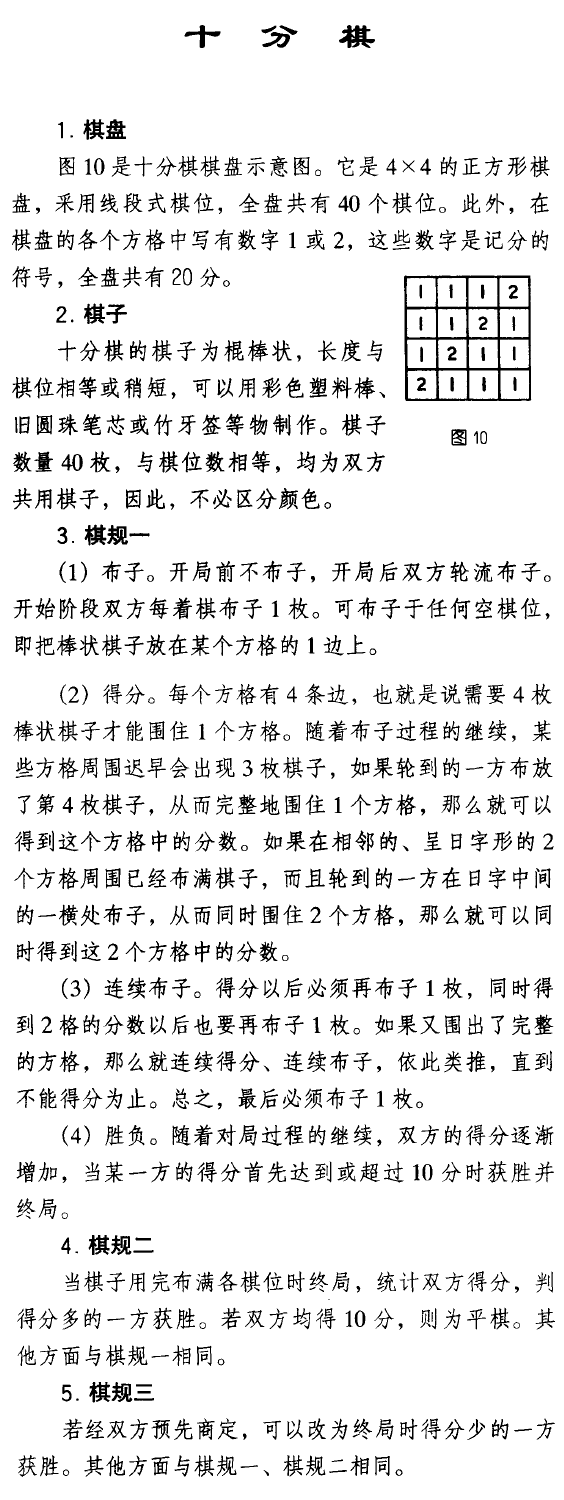
Ten-Point Chess (十分棋)

1. The Board

Figure 10 shows the Ten-Point Chess board.

It is a 4×4 square board using line-segment positions, with a
total of 40 positions.

In addition, each square on the board contains the number 1 or 2.
These numbers represent scoring values.

The total score available on the board is 20 points.

2. Pieces

The pieces in Ten-Point Chess are stick-shaped, with a length equal
to or slightly shorter than the edge of a board square.

They may be made from colored plastic sticks, old ballpoint pen refills,
bamboo toothpicks, or similar objects.

There are 40 pieces, equal to the number of positions. All pieces are
shared by both players, so no color distinction is required.

3. Rules I
(1) Placement

Before the game begins, no pieces are placed.
After the game starts, players take turns placing pieces.

In the initial phase, on each turn a player places one piece.

A piece may be placed on any empty position, that is, placing a
stick-shaped piece along one side of a square.

(2) Scoring

Each square has four sides, meaning four stick pieces are required
to completely surround one square.

As placement continues, some squares will gradually have three sides
occupied. If the player whose turn it is places the fourth piece,
thereby completely enclosing a square, that player scores the points
shown in that square.

If two adjacent squares in a “日”-shaped (rectangular) configuration
are already surrounded on all sides except for the shared middle edge,
and the player places a piece on that middle edge, thereby enclosing
both squares simultaneously, the player scores the points from both
squares at once.

(3) Consecutive Placement

After scoring, the player must place one additional piece.

If two squares are scored at once, the player must still place
one additional piece afterward.

If placing a piece encloses another complete square, the player
scores again and continues placing, and so on, until no further
points can be scored.

In short, the player must always end by placing one piece.

(4) Victory and Defeat

As the game progresses, both players’ scores increase.
When one player’s score first reaches or exceeds 10 points, that
player wins immediately and the game ends.

4. Rules II

If all pieces are used up before all positions are filled, the game
ends and both players’ scores are totaled.

The player with the higher score wins.

If both players score 10 points, the result is a draw.

All other rules are the same as in Rules I.

5. Rules III

If agreed upon in advance by both players, the victory condition
may be changed so that the player with the lower score at the end wins.

All other rules are the same as in Rules I and Rules II.
.gif)
Wuhuqí (Five-Tiger Game)

Wuhuqí, also known as Five Tigers, Fangcheqi, Dabianqi, Xiabián, Sanxing Sì,
Wuhuqi, Wumaqi, Changjiangqi, etc., is a two-player abstract strategy game
widely played in many regions of China.

1. Setup

The Wuhuqí board is shown in the diagram. It consists of 16 squares and
25 intersections. There are 25 pieces in total: one player has 13 pieces,
the other 12 pieces. The pieces are distinguished by color. Players take
turns placing pieces on the board.

2. Scoring and Capturing

Players aim to form specific target patterns.
When a player successfully forms a target pattern, they may capture a
fixed number of opponent pieces. However, pieces that have already formed
part of a completed pattern may not be captured again.

Once the board is completely filled, players capture pieces according
to the patterns they form. If neither player can form a target pattern,
each player captures one piece.

After this, the first player captures first, then the second player,
and afterwards players alternate turns.

(Diagram caption: Wuhuqí board)

Target Patterns in Wuhuqí

Five Tigers (also called Five Nests):
    Divided into central tiger and edge tiger.
    Five connected pieces in a horizontal or vertical line.
    Capture 3 pieces.

Tongtian (also called Great Tiger or Large Tiger):
    Five connected pieces in a diagonal line.
    Capture 4 pieces.

Small Well (also called Square, Small Square, or Little Well):
    Four pieces forming a square.
    Capture 1 piece.

Three-Slash (also called Small Slash):
    Three connected pieces in a diagonal line.
    Capture 1 piece.

Four-Slash:
    Four connected pieces in a diagonal line.
    Capture 2 pieces.

3. Victory

The player who captures all of the opponent’s pieces wins the game.

(Ying Minyan, Zhang Xuebo, Chen Chunjun, Li Chun)
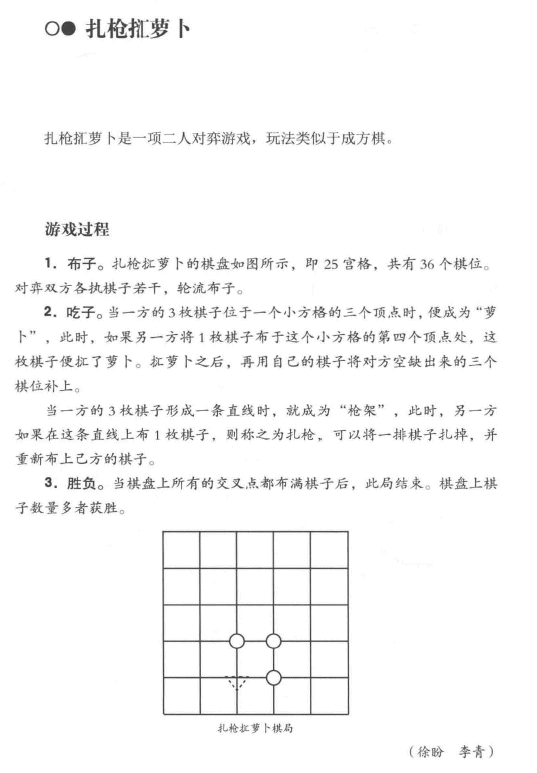
扎枪扯萝卜 (Zhaqiang Che Luobo)

Zhaqiang Che Luobo is a two-player abstract strategy game. Its gameplay is
similar to Nine Men’s Morris.

Game Procedure

1. Board Setup

The board is shown in the diagram. It consists of 25 cells, with 36 intersection
points. The two players take turns placing their pieces, starting with Black.

2. Forming “Radishes” and “Spears”

When three pieces form a small right-angled shape occupying three vertices of
a small square, this configuration is called a “radish” (萝卜).

If one player places a piece on the fourth vertex of that small square, the
piece captures the radish.

After capturing a radish, the capturing player uses their own pieces to occupy
the three intersections vacated by the opponent.

When three pieces form a straight line, this is called a “spear” (枪架).

If the opponent has one piece on that straight line, it is considered blocked (扎枪).

In this case, the player may capture an entire row of pieces, and then re-place
pieces at the top of the board.

3. Victory Conditions

When all intersection points on the board are filled, the game ends.
The player who has more pieces on the board wins.

Diagram: Board layout for Zhaqiang Che Luobo

(Xu Yin, Li Chun)
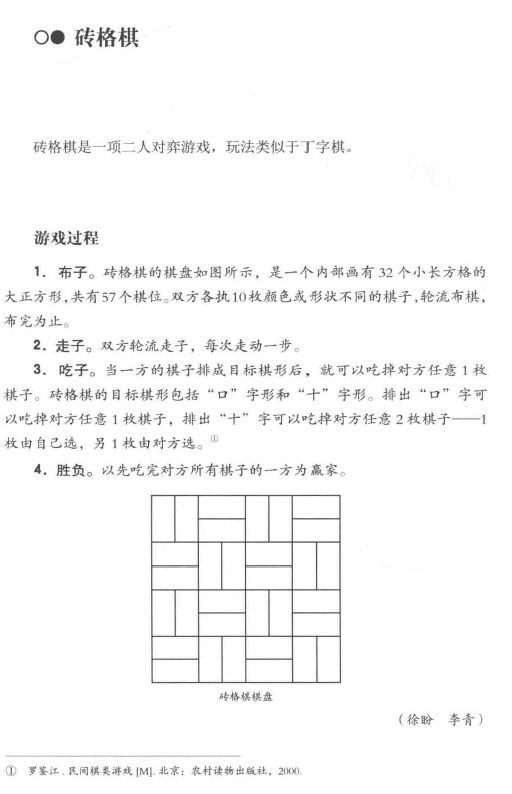
砖格棋 (Zhuān Gé Qí)

Zhuan Ge Qi is a two-player abstract strategy game. Its gameplay is similar to Tic-Tac-Toe.

Game Procedure

1. Board Setup

The board is shown in the diagram. It is a large square subdivided internally
into 32 small rectangles, with a total of 57 intersection points.

Each player has 10 pieces, distinguished by color or shape. Players take turns
placing pieces, starting with Black. Placement continues until all pieces have
been placed.

2. Moving Pieces

After all pieces are placed, the two players take turns moving.
On each turn, a player may move one piece by one step.

3. Capturing

When one player’s pieces form a target pattern, that player may capture the opponent’s pieces.

The target patterns in Zhuan Ge Qi include:

the “口” (square) shape
the “十” (cross) shape

If a “口” shape is formed, the player may capture any one of the opponent’s
pieces.

If a “十” shape is formed, the player may capture any two of the opponent’s
pieces — one of which must be the piece that just moved. One piece is decided by the current player, and the other is decided by the adversary.

4. Winning the Game

The player who first captures all of the opponent’s pieces wins the game.

Diagram: Zhuan Ge Qi board

(Xu Yin, Li Chun)

Reference:
① Many Types of Folk Board Games, Beijing: Agricultural Publishing House, 2000.
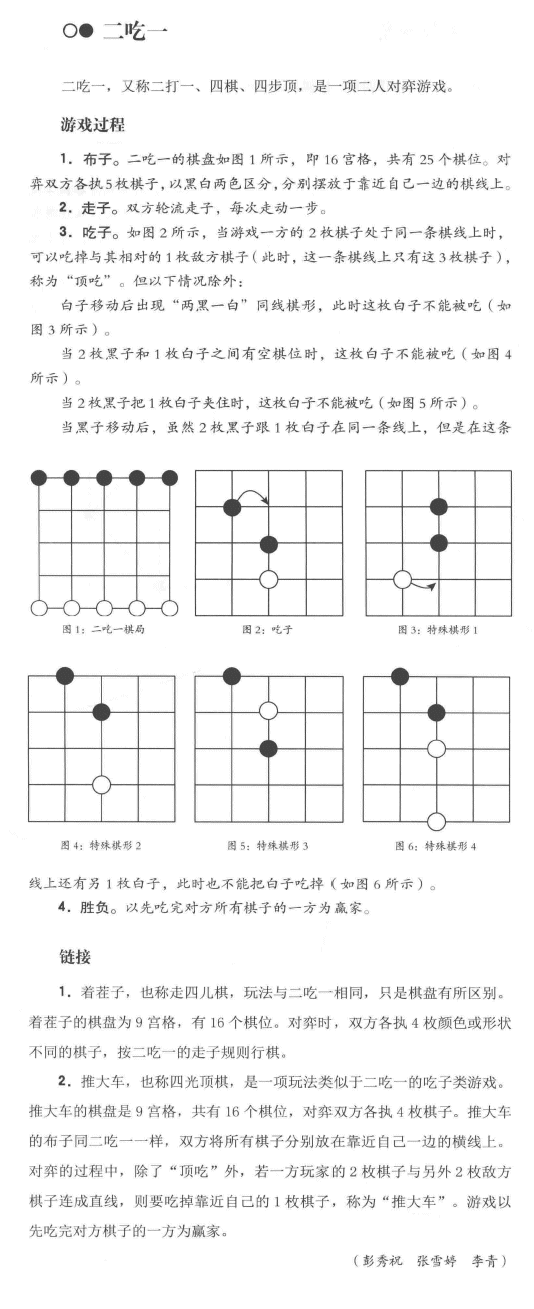
Er Chi Yi, also known as “Two Capture One”, “Four Squares”, or “Four-Step Top”,
is a two-player abstract strategy game.

Game Procedure
1. Board Setup

The board is shown in Figure 1. It consists of 16 cells with 25 intersection
points. Each player has 5 pieces. During setup, players take turns placing
pieces, and all pieces must be placed on the row of intersections closest to
the player.

2. Movement

After setup, players take turns moving.
On each turn, a player may move one piece by one step.

3. Capturing

Figure 2 = capture.

As shown in Figure 2, when one player has two pieces on the same line,
and there is one opponent piece adjacent on that line, the opponent’s piece
may be captured (at that moment, there are three pieces on the same line).

This capture is called “top” (顶吃) and is similar to capturing in Tic-Tac-Toe.

Figure 3-6 = no capture.

However, there are several special configurations in which capturing is not
allowed:

If, after moving, the configuration “Two Blacks, One White” appears on the same
line, the white piece cannot be captured (see Figure 3).

If there is an empty space between the two black pieces and the white piece, the
white piece cannot be captured. The 3 stones should be adjacent. (see Figure 4).

If the two black pieces are adjacent to the white piece, the white piece cannot
be captured. Only O-O-X, no O-X-O. (see Figure 5).

If, after a move, although the two black pieces and the white piece are on the
same line, there is another piece elsewhere on that line, then the white piece
still cannot be captured (see Figure 6). Their can't be irrelevant stones on that line.

4. Winning the Game

The player who first captures all of the opponent’s pieces wins.

Related Games

1. 着棋子 (Zhuo Qi Zi)

    Also called Four-in-a-Row, this game has rules identical to Er Chi Yi, differing only in the board.

    The board has 9 cells and 16 intersection points.
    Each player has 4 pieces, distinguished by color or shape.
    Gameplay follows the same movement and capture rules as Er Chi Yi.

2. 推大车 (Tui Da Che)

    Also known as “Pushing the Cart”, this is a two-player abstract game with
    gameplay similar to Er Chi Yi.

    The board consists of 9 cells with 16 intersection points.
    Each player has 4 pieces, initially placed on the row of intersections
    closest to the player.

    During play, in addition to “top” captures, if one player’s two pieces form
    a straight line with two opponent pieces, the player must capture one of
    their own pieces closest to themselves; this is called “pushing the cart”.

    The winner is the player who first captures all of the opponent’s pieces.

(Peng Xiangqi, Zhang Xuanqi, Li Chun)
六子冲棋 (Liu Zi Chong Qi)

Liu Zi Chong Qi, also known as Chongqi, Arrow Chess, or Cannon Chess,
is a two-player abstract strategy game widely played in Sichuan and Hubei.
Each player has six pieces, hence the name “Six-Piece Chong.”

Game Procedure

1. Board Setup

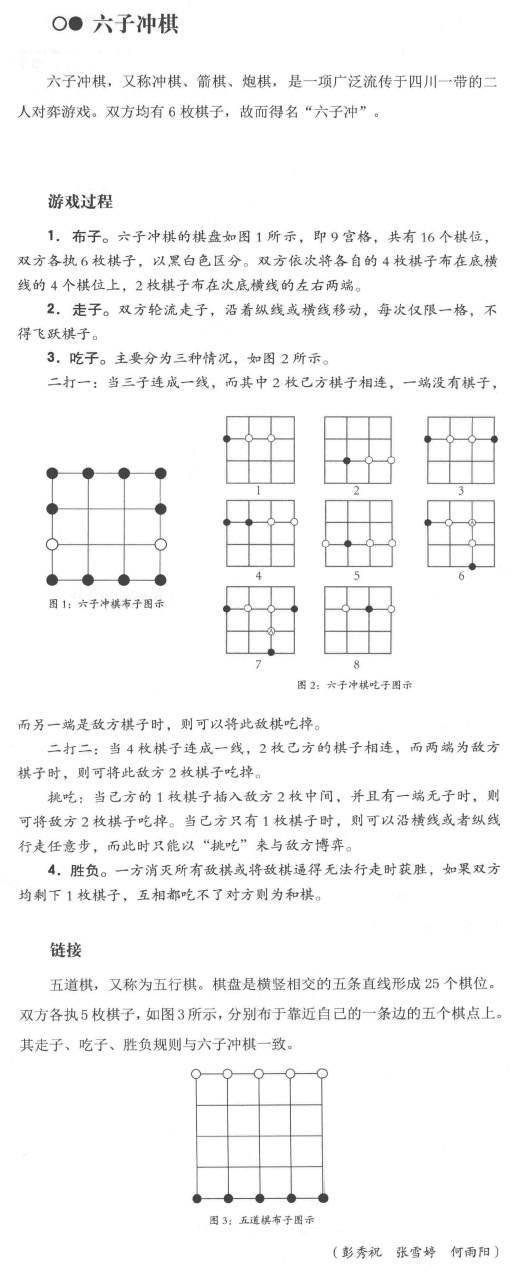
The board is shown in Figure 1. It consists of 9 cells with 16 intersection
points. Each player has 6 pieces, distinguished by black and white.

Players alternately place their pieces as follows:

Four pieces are placed on the four intersections of the bottom row.

Two pieces are placed on the left and right ends of the row just above the
bottom row.

2. Movement

Players take turns moving.
Pieces may move horizontally, vertically, or diagonally, but only one step at
a time. Jumping over other pieces is not allowed.

3. Capturing

Capturing occurs mainly in three situations, as shown in Figure 2.

(1) Two-against-one (二打一)

When three pieces form a straight line, and two adjacent pieces belong to one
player, while the third end point is empty, if the other end is occupied by an
opponent’s piece, that opponent’s piece may be captured.

(2) Two-against-two (二打二)

When four pieces form a straight line, with two adjacent pieces belonging to
one player, and both ends occupied by opponent pieces, the player may capture
both opponent pieces.

(3) Cannon Capture (挑吃)

If a player inserts one of their pieces between two opponent pieces, and
one end of the line is empty, the player may capture the two opponent pieces.

After making a capture, the capturing piece may then move one step horizontally
or vertically, and may continue capturing using the cannon capture method.

4. Winning the Game

A player wins by capturing all of the opponent’s pieces, or by blocking
the opponent so that none of their pieces can move.

If both players are reduced to one piece each, and neither can capture
the other, the game is a draw.

Related Game

五道棋 (Wu Dao Qi)

Also called Five-Line Chess.

The board is formed by five vertical and five horizontal straight lines,
creating 25 intersection points.
Each player has 5 pieces, as shown in Figure 3, placed on the five
intersections closest to their side.

The rules for movement, capturing, and winning are the same as
in Liu Zi Chong Qi.

(Peng Xiangqi, Zhang Xueqi, He Yujian)

--------- Mingyang Tian (lk758tmy) comments:

Stones can only be moved orthogonally, and can't be moved diagonally.

Besides, when a player only have one stone left, that stone can be moved as many
steps you want in the same direction (like Rook in Chess).

I'm not sure with the capturing rule of this game. The text does not match the
figures exactly. (For instance, according to the text, only figure3 is counted
as Two-against-two, and figure4 is not.) And the rules I found on the internet
said other things.

It's the common status of many folk games: rules varies among regions, and only
locals know the exact rules they play. (Rules on the Internet are always a "mix"
of different local rules, and may contradict itself.)
杀蜀黍 (Sha Shu Shu)

Sha Shu Shu is a two-player abstract strategy game that is widely played
in the Bazhong–Nanchong–Guang’an region of Sichuan.

Because the pieces placed on the board resemble the drooping heads of
ripened sorghum (蜀黍) after harvest, the game is also known as Sorghum
Chess, Harvest Sorghum Chess, or Cutting Sorghum Chess.

In areas where Sha Shu Shu is popular, people often sing the following rhyme:

“I’ll teach you a tune,
 I’ll teach you a little game,
 I’ll teach you the southern Sichuan Sha Shu Shu.”

Game Procedure

1. Board Setup

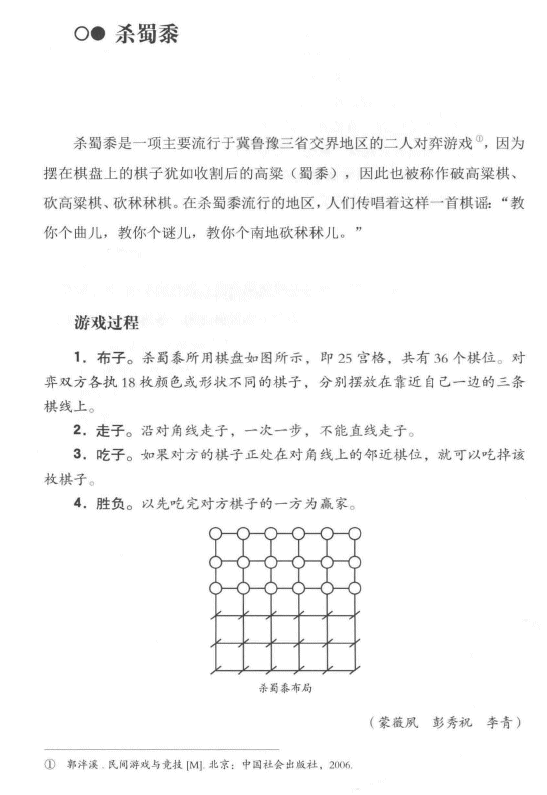
The board is shown in the diagram. It consists of 25 cells with 36 intersection
points. Each player has 18 pieces, distinguished by color or shape.

Players place their pieces on the three rows of intersections closest to their
own side.

2. Movement

Pieces move along diagonal lines only, one step per move.
Moving along straight (horizontal or vertical) lines is not allowed.

3. Capturing

If one of your opponent’s pieces is located on an adjacent intersection
directly opposite yours along a diagonal, you may capture that piece.

4. Winning the Game

The player who captures all of the opponent’s pieces first wins.

Diagram: Sha Shu Shu board layout

(Cai Rongqing, Peng Xiangqi, Li Chun)

Reference:
① Guo Yuxian, Folk Games and Traditional Skills, Beijing:
China Social Sciences Press, 2006.
Xiàliù Qí (下六棋)

Xiàliù Qí, also called Xiàliù, is a two-player abstract board game popular
in the Jiangsu region of China. It developed from ancient Liùbó (Six Bo)
and is believed to have spread during the Three Kingdoms period, especially
in the Huai River basin of Jiangsu and northern Jiangsu.

Gameplay

1. Setup

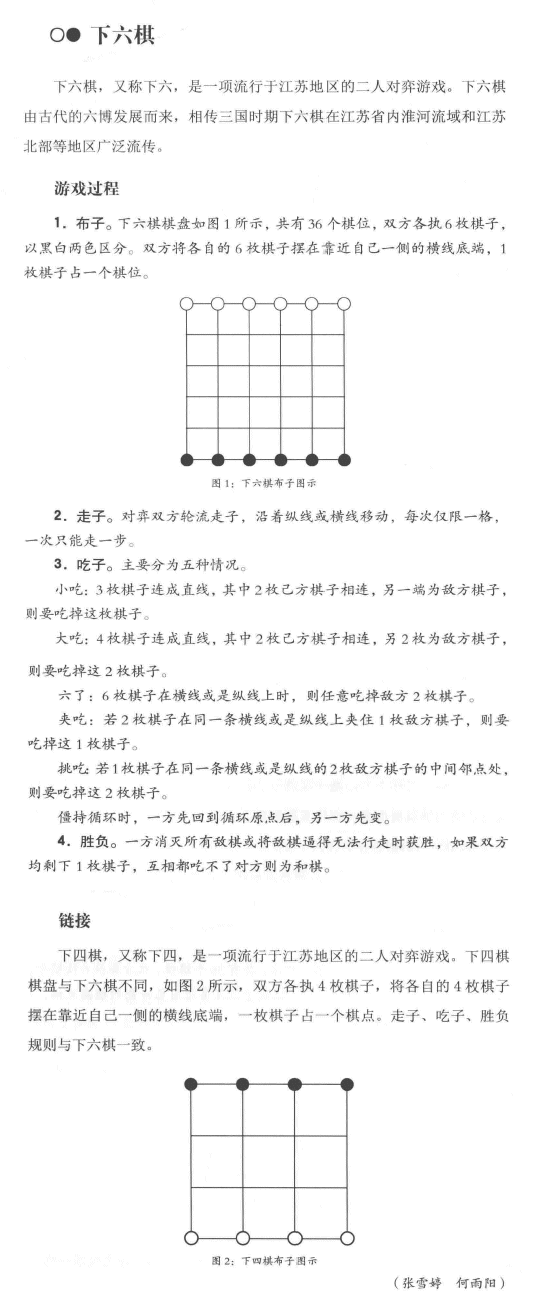
The Xiàliù Qí board is shown in Figure 1 and consists of 36 intersections.
Each player has 6 pieces. The two players sit opposite each other.

Each player places their 6 pieces on the row of intersections closest to
them, with one piece occupying each intersection.

2. Movement

The two players take turns alternately. Pieces move either horizontally
or vertically, and each move is limited to one step. Only one piece may
be moved per turn.

3. Capturing

Capturing is divided into five main cases:

Minor capture (小吃):
Three pieces form a straight line, with two adjacent pieces belonging to
one player and the piece at the other end belonging to the opponent.
The opponent’s piece is captured.

Major capture (大吃):
Four pieces form a straight line, with two adjacent pieces belonging
to one player and the other two belonging to the opponent. Both opponent
pieces are captured.

Complete capture (全了):
When six pieces lie on the same horizontal or vertical line, the player
may freely capture any two opponent pieces.

Advanced capture (夹吃):
If two pieces are on the same horizontal or vertical line and sandwich
one opponent piece between them, that opponent piece is captured.

Center capture (掏心):
If one piece occupies the center point between two opponent pieces on
the same horizontal or vertical line, the two opponent pieces are captured.

After a capture, one player continues until no further captures are
possible, then the turn passes to the opponent.

4. Winning Conditions

A player wins by capturing all of the opponent’s pieces or by rendering
the opponent unable to make any legal move.

If both players are left with one piece each and neither can capture the
other, the game is a draw.

Linked Variant
Xiàsì Qí (下四棋)

Xiàsì Qí, also called Xiàsì, is a two-player abstract game popular in
the Jiangsu region.

Its board differs from Xiàliù Qí, as shown in Figure 2. Each player has
four pieces, placed on the row of intersections closest to them, with
one piece per intersection.

Movement, capturing, and victory conditions are the same as in Xiàliù Qí.

(Source: Zhang Xuehua, He Yutian)
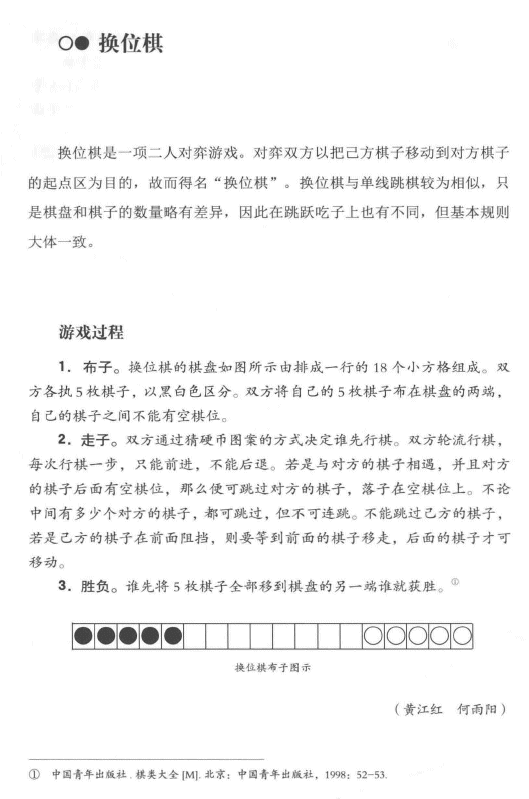
Huànwèi Qí (换位棋) — “Position-Swapping Game”

Huànwèi Qí is a two-player abstract strategy game. The objective for each
player is to move all of their own pieces to the starting area of the
opponent, hence the name “Huànwèi Qí” (“Position-Swapping Game”).

Huànwèi Qí is similar in spirit to Shànxiàn Qí (Single-Line Chess),
differing mainly in the number of board spaces and pieces. Because of
this, there are also differences in jumping and capturing, but the basic
rules are largely the same.

Gameplay
1. Setup

As shown in the diagram, the Huànwèi Qí board consists of a single row
of 18 small squares.

Each player has 5 pieces, distinguished by black and white. Players place
their 5 pieces on opposite ends of the board. There must be no empty squares
between a player’s own pieces.

2. Movement

The player to move is determined by agreement or by lot, and the two
players then alternate turns.

On each turn, only one piece may be moved, and it may only move forward,
never backward.

If a piece encounters an opponent’s piece and there is an empty square
immediately beyond it, the moving piece may jump over the opponent’s piece
and land on the empty square. No matter how many opponent pieces lie in
between, they may all be jumped over, but jumps may not be chained
consecutively.

A player may not jump over their own pieces. If a player’s own piece is
blocking the way ahead, the player must wait until the blocking piece
moves before pieces behind it may advance.

3. Winning Conditions

The first player to move all 5 of their pieces to the opposite end of
the board wins.

(Source: Huang Jianghong, He Yutian)
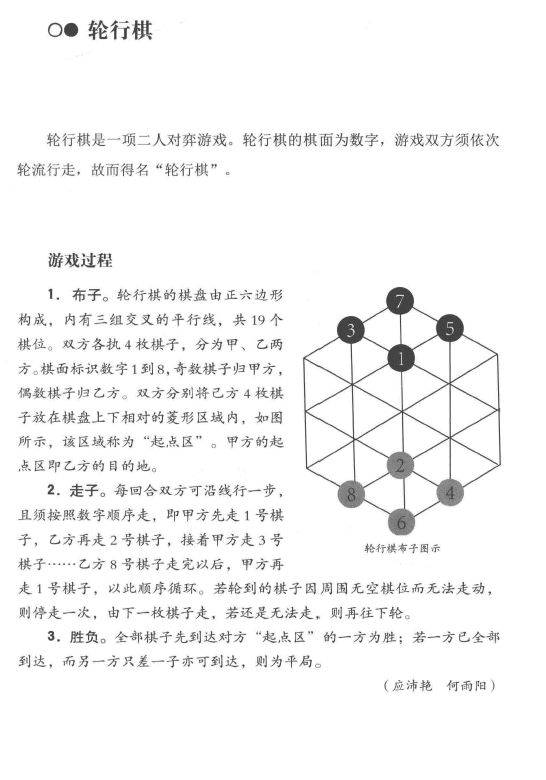
Lúnxíng Qí (轮行棋)

Lúnxíng Qí is a two-player abstract board game. The board has numbered
spaces, and the two players move alternately in rotation, hence the name
“Lúnxíng Qí” (“Rotational Movement Chess”).

Gameplay
1. Setup

The board of Lúnxíng Qí consists of a regular hexagon formed by three
sets of intersecting parallel lines, for a total of 19 spaces.

Each player has 4 pieces. Player A moves first, followed by Player B.
The spaces are numbered from 1 to 8. Odd-numbered spaces belong to
Player A, and even-numbered spaces belong to Player B.

Each player places their 4 pieces in the shaded region on opposite sides
of the board, as shown in the diagram. These regions are called the
“starting areas.” Player A’s starting area is also Player B’s target
area, and vice versa.

2. Movement

In each round, both players may make one move, and they must move
according to the numerical order of the spaces.

That is:

    Player A moves the piece on space 1,
    Player B moves the piece on space 2,
    Player A moves the piece on space 3,
    Player B moves the piece on space 4,
    …
    Player B moves the piece on space 8,
    Player A moves the piece on space 1 again, and so on in this cycle.

If the piece whose turn it is cannot move because all adjacent spaces
are occupied, the player skips that move and proceeds to the next numbered
piece. If it still cannot move, the turn passes to the opponent, and
the cycle continues.

3. Winning Conditions

If one player moves all of their pieces into the opponent’s “starting area,”
that player wins.

If one player has achieved this condition and the other player can also
achieve it with their remaining piece(s), the game is a draw.

(Source: Ying Qingdi, He Ertian)
.gif)
Shuangtian Qi (Double-Field Game)

Shuangtian Qi, also known as Defensive Chess, is a two-player adversarial game.

The board of Shuangtian Qi is formed by two “field” (田) shapes rotated
45 degrees and joined together, hence the name “Double-Field Game”.

Game Procedure

1. Setup

The Shuangtian Qi board has a total of 17 positions. Each player has 8 pieces,
distinguished by red/black or black/white pieces. For ease of explanation,
the positions are numbered: one group is numbered 1–8, and the other group
10–17. Position 9 is empty at the start.

Each player places their pieces on one side of the board along the same
numbered positions, leaving position 9 empty. As shown in the diagram, pieces
numbered 1–8 are placed on the left side of the board, and pieces numbered
10–17 are placed on the right side.

2. Movement

The objective of movement in Shuangtian Qi is to exchange the positions of
one’s pieces with those of the opponent. The exact positions occupied by
individual pieces do not matter.

There are two main types of moves:

Step move:
Move a piece to an adjacent empty position.

Jump move:
A piece jumps over an adjacent piece and lands on an empty position beyond it.
The jumped-over piece remains in place; the color of the jumped piece does
not matter.

3. Victory Conditions

The two players attempt to exchange their piece positions. A player wins if
they successfully complete the exchange of positions; otherwise, they lose.

Diagram: Shuangtian Qi piece layout

References
Zhou Wei, Collected Folk Games, Vol. 1, Beijing:
People’s Sports Publishing House, 2009, p. 252.
This is a Halma-like game.
.gif)
Jian Di Qi is a two-player adversarial game. Its gameplay is similar to
Tonggu Qi found in Chinese folk board games.

Game Procedure

1. Setup

The Ya Gu Qi board is based on a 16-square grid, with diagonal connections
added between the squares, for a total of 41 positions. Each player has
9 pieces, which may be distinguished by color or by shape. The pieces are
placed on the two rows of points closest to each player’s own side of the
board.

2. Movement

The two players alternate turns. On each turn, a player may move only one
piece by one step.

3. Capture

If a player’s piece moves to a point adjacent to an opponent’s piece, and
the two points are connected by a line, then if three pieces lie in a straight
line on the same connection, and the opponent’s piece is in the middle, that
middle piece is captured and removed from the board.

4. Victory Conditions

The player who first captures all of the opponent’s pieces wins.
If, after a piece is captured, neither player is able to capture any
further opponent pieces, the game is considered a draw.

Diagram: Ya Gu Qi board setup

(Huang Jianghong · Li Chun)
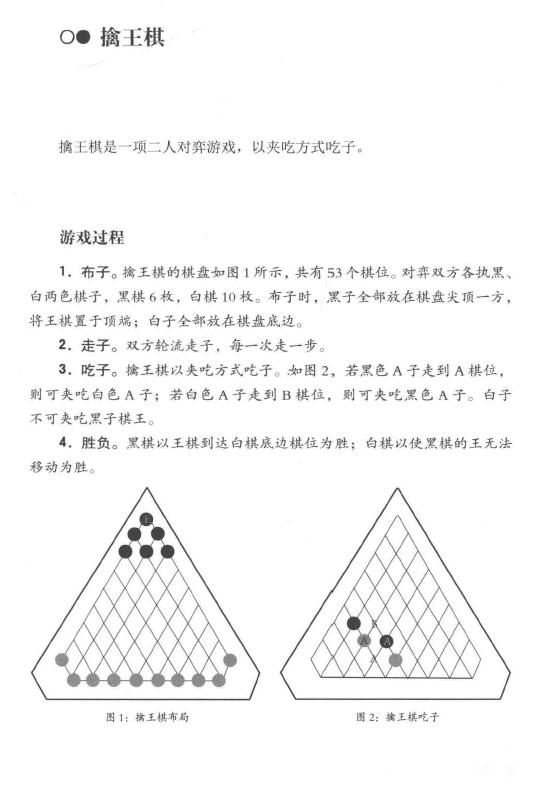
Capture King Game is a two-player abstract board game. Pieces are
captured by pulling.

Game Procedure

1. Setup

The Tug-of-War Chess board is shown in Figure 1 and has a total of
53 intersections. One player takes the black pieces and the other the white
pieces.

Black has 6 pieces
White has 10 pieces

At the start, all black pieces are placed at the top of the board, and all
white pieces are placed along the bottom edge of the board.

2. Movement

Players alternate turns. On each turn, a player makes one move.

3. Capturing

Capturing in Tug-of-War Chess is done by pulling, as shown in Figure 2.

If a black piece A moves to point A, it captures the white piece at point A.
If a white piece A moves to point B, it captures the black piece at point A.

White pieces may not capture black pieces by pulling from the black
player’s starting area.

4. Victory Conditions

Black wins by pulling its pieces to reach the bottom edge of the board.

White wins if it makes the black pieces unable to move.

    Figure 1: Initial setup of Tug-of-War Chess
    Figure 2: Capturing by pulling in Tug-of-War Chess
Three-Friends Chess (三友棋)

Three-Friends Chess is a two-player abstract board game. Because its board
is similar to that of international chess, and because many of its pieces
use encircling captures rather than direct captures as in Go, it is therefore
called “Three-Friends Chess.”

Game Procedure

1. Setup

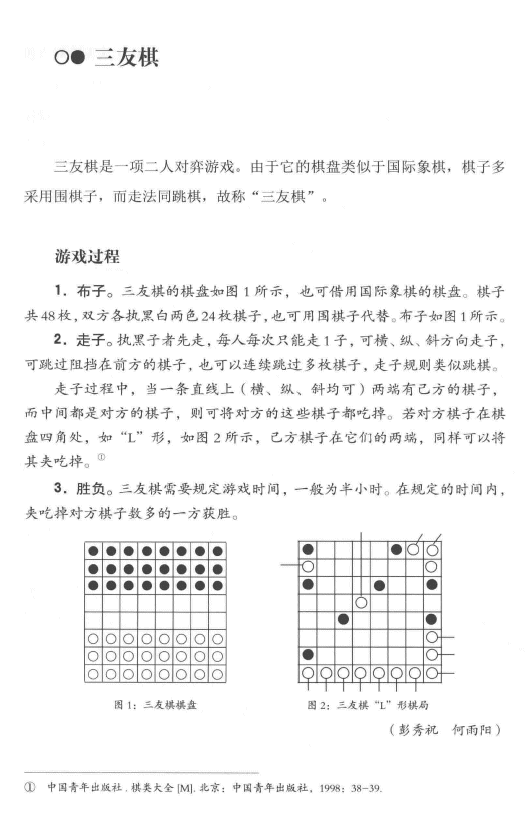
The board for Three-Friends Chess is shown in Figure 1; a standard
international chessboard may also be used.

Each side has 48 pieces, for a total of 96 pieces. Pieces may be placed
directly on the intersections of the board, as shown in Figure 1.

2. Movement and Capture

Black moves first. Each move consists of moving one piece.

A piece may move one step horizontally or vertically, or diagonally. It may
pass over pieces that block the way, and may also capture multiple opponent
pieces in a single move. The movement rules are similar to those of Go.

During movement, if along a straight line (horizontal, vertical, or diagonal)
there are pieces of both sides, and the opponent’s pieces lie between two of
the player’s own pieces, then all those opponent pieces are captured.

If the opponent’s pieces are arranged at the edge of the board in an
“L” shape, as shown in Figure 2, the opponent’s pieces located at both
ends are also captured in the same way.

3. Victory Conditions

Three-Friends Chess requires a time limit, generally about half an hour.
When the specified time expires, the player who has captured more opponent
pieces wins.

Figure 1: Initial setup of Three-Friends Chess
Figure 2: “L”-shaped capture in Three-Friends Chess

(Reference: He Jinduo)
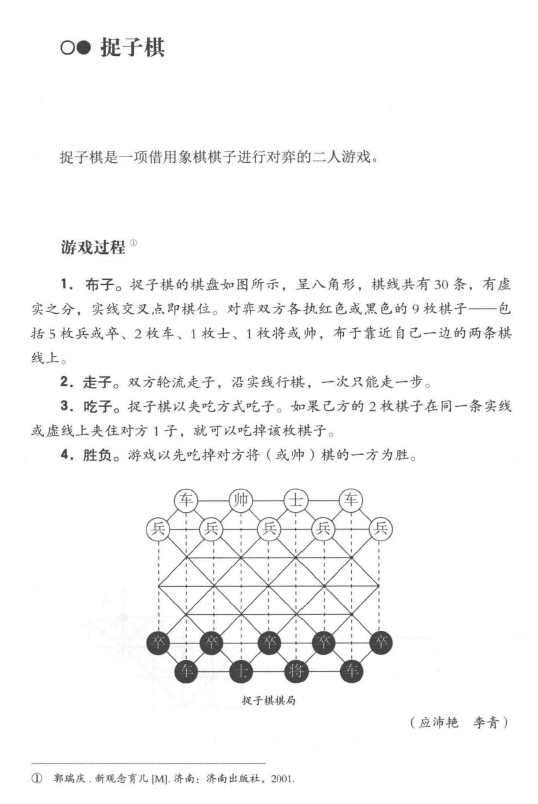
Jiezi Chess is a two-player game played using Chinese-chess (Xiangqi) pieces.

Game Procedure

1. Setup

The Jiezi Chess board is shown in the figure. It has a diamond shape and
a total of 30 intersections. There are solid lines, dashed lines, and
intersections.

Each player has 9 pieces, either red or black. The pieces are:

    5 Soldiers (兵 / 卒)
    2 Rooks (车)
    1 Scholar (士)
    1 General (将 / 帅)

All pieces are placed on the two rows of intersections nearest to the
player’s own side.

2. Movement

Players alternate turns. Pieces move along the lines, and each move advances

one step only.

3. Capturing

Jiezi Chess uses encircling capture.

If two pieces of the same side are on the same straight line or dashed line,
and an opponent’s piece lies between them, that opponent piece may be captured.

4. Victory Conditions

The player who captures the opponent’s General (将 / 帅) wins the game.

Figure: Initial setup of Jiezi Chess

(Reference: Lu Qingyan, Li Yu)

-------------- Mingyang Tian comments:

Many details are missing in the original text.

I assume it only "borrows" pieces from Xiangqi, so there is no distinguish between 兵/卒, 车 and 士. (将/帅 matters for the goal.)
This is a Chess-like game, see details for rules.
Crossing-the-Sea Chess (渡海棋)

Crossing-the-Sea Chess is a two-player or three-player board game. The central
part of the Crossing-the-Sea Chess board represents the sea. The two sides set
out from islands or mountains, and crossing the sea to reach the destination is
the objective; hence the name of the game.

Game Procedure

Method of Play I

1. Setup

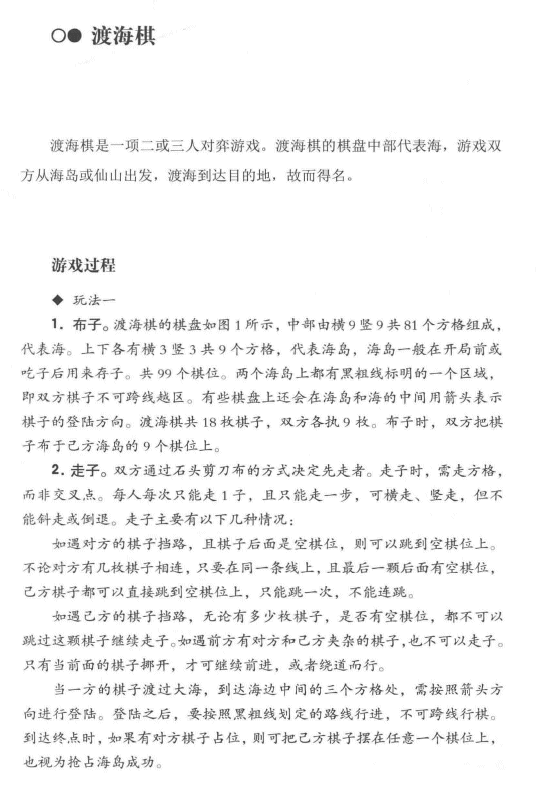
The board of Crossing-the-Sea Chess is shown in Figure 1. The central area
consists of 9 × 9 = 81 squares, representing the sea. At the top and bottom
there are 3 × 3 = 9 squares each, representing islands. The islands are
generally depicted as eating areas or backward areas. In total there are
99 squares.

The two sides each have an island, with a sea area between them. The sea area
may contain squares that pieces may not pass through. Some squares also
indicate the direction of movement for pieces entering or leaving the sea area.

Crossing-the-Sea Chess uses 18 pieces in total, with each side having 9 pieces.
During setup, both sides place their pieces on the 9 squares of their
respective islands.

2. Movement

The two sides decide the first player by rolling dice or drawing lots. During
play, a piece moves by stepping from square to square. Each player may move
only one piece per turn, and each move consists of only one step. Pieces may
advance, retreat, or move sideways, but they may not remain stationary or move
backward illegally.

The main types of movement are as follows:

If a piece is blocked by an opponent’s piece and the square behind that piece
is empty, it may jump onto that square. The direction of movement does not
matter. If there are several pieces in a row, and the square behind the last
piece is empty, the jump is allowed. A jump may be made only once per turn and
may not be repeated.

If a piece is blocked by one of the player’s own pieces, regardless of how many
pieces there are or whether there are empty squares, it may not jump over them
to continue moving. If the way is blocked by both an opponent’s piece and the
player’s own piece, movement is also not allowed.

Only when a piece reaches the “bridge” may it move across the sea. After
crossing the bridge, it enters the three squares in the middle of the sea area
and must proceed according to the required direction.

When a piece reaches an island, it must follow the route prescribed by the
rules. It may not jump over other pieces.

Upon reaching the destination, if an opposing piece occupies that square, the
player may place their own piece on top of the opponent’s piece, thereby
capturing it. This is considered a successful crossing of the sea.

3. Victory and Defeat

Whichever side is the first to have all 9 of its pieces reach the destination
island wins.

Method of Play II: Three-Player Game

1. Setup

The board for the three-player version of Crossing-the-Sea Chess is shown in
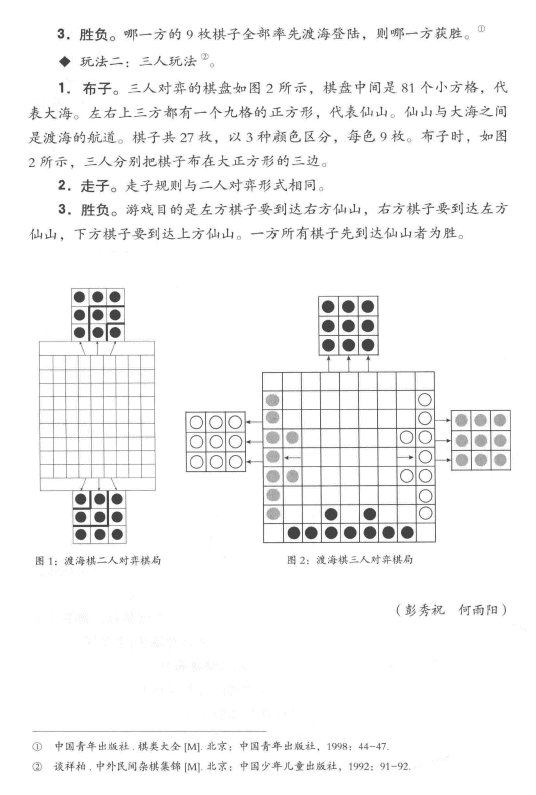
Figure 2. The central area of the board consists of 81 small squares,
representing the sea. On the left, right, and top sides there is a square area
of 9 squares each, representing mountains. The passages between the mountains
and the sea are the routes for crossing the sea.

There are a total of 27 pieces, divided into three colors, with 9 pieces for
each player. During setup, as shown in Figure 2, the three players place their
pieces on the three sides of the square mountain areas.

2. Movement

The movement rules are the same as those for the two-player version.

3. Victory Conditions

The objective of the game is as follows:

The player on the left must move their pieces to the right-side mountain.
The player on the right must move their pieces to the left-side mountain.
The player at the bottom must move their pieces to the top-side mountain.
The first player to have all of their pieces reach the destination mountain wins.

Figure 1: Initial setup for the two-player Crossing-the-Sea Chess
Figure 2: Initial setup for the three-player Crossing-the-Sea Chess

(For reference: He Nanmin)

References:

China Youth Press. Collected Works on Chess and Board Games [M].
Beijing: China Youth Press, 1998, pp. 44–47.

Crossing-the-Sea Chess, in Collection of Chinese Folk Games [M].
Beijing: China Children’s Publishing House, 1992, pp. 91–92.
Crossing the Sea (渡海棋)

Material:

As in the figure. The 9*9 board represents the sea, the two 3*3 boards
represent the islands.
When moving a piece from the sea to the island, or from the island to the sea,
it can only be moved along the arrow.
When moving a piece inside the island, it cannot cross the bold lines.

Movement:

On each turn, move one piece one step forward or sideways. Neither retreating
nor diagonal movement is allowed.
A piece can also jump over adjacent adversary piece(s) (a single piece or
several pieces in a row) on those 3 directions, and land on the first empty
square behind it/them. Note that if a piece jump over several pieces, all
of them must be adversary piece.

Goal:

Winner is the first player who moves all your pieces into the opposite island.
If you move a piece into the island, and there's an adversary piece on the
island that blocks your way, you can directly jump over it.

3-player-variant:

As in the figure. For setup, pieces are staring in the sea instead of on the island.
This is a Halma-like traversal game. Check details for the rules.
Pairing Chess (对子棋)

Pairing Chess is a two-player abstract strategy game. It is called
Pairing Chess because each player places two stones per turn.

Game Procedure

1. Setup

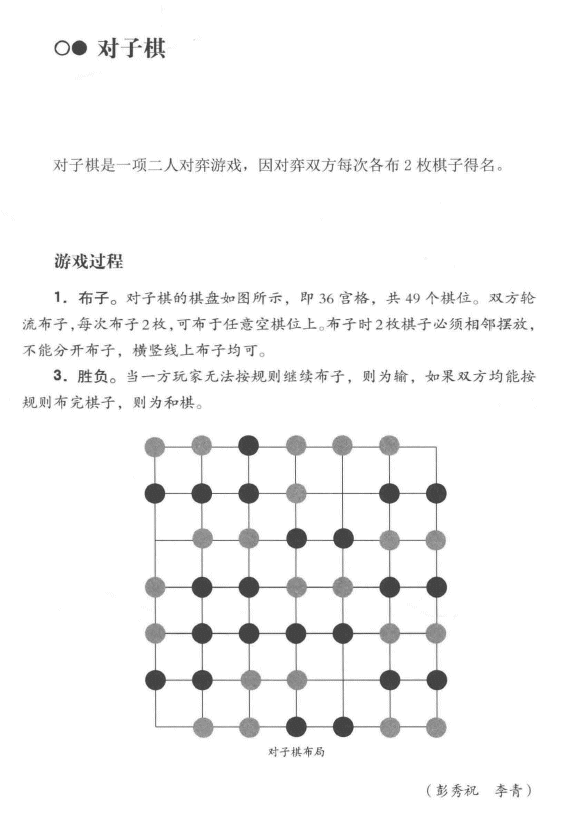
The Pairing Chess board is shown in the diagram. It consists of 36 cells
and 49 intersection points.

The two players take turns placing stones. On each turn, a player places two
stones, which may be placed on any empty intersections on the board.
However, the two stones placed in a single turn must be adjacent to each other
and may not be separated.

Stones may be placed either horizontally or vertically.

3. Win/Loss

If a player is unable to continue placing stones according to the rules,
that player loses.

If both players are unable to place stones according to the rules,
the game is a draw.

Diagram

Pairing Chess board position
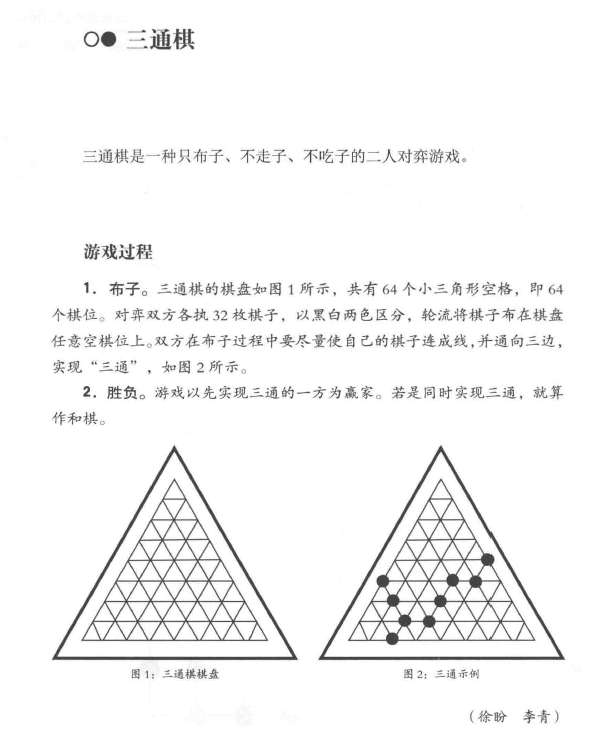
Three-Connection Game (三通棋)

Three-Connection is a two-player abstract connection game played on
a triangular board. Players take turns placing stones only; there
is no movement and no capture.

The objective is to form a connected group of stones that touches all three
sides of the board.

Equipment

A triangular board subdivided into a triangular lattice with 64 intersection points.

32 stones for each player, in two different colors.

Setup

The board starts empty.
Players choose a color.
Either player may move first.

Play

Players alternate turns.

On a turn, a player:

  Places one stone of their color on any empty intersection of the board.

Stones, once placed, remain fixed for the rest of the game.

Connectivity is defined by adjacent intersections connected by the edges
of the triangular grid.

Objective (Winning Condition)

A player wins immediately upon forming a single connected group of their stones
that touches all three sides of the triangular board.

Touching a side means that at least one stone in the connected group lies on
that side of the board.

Draw

If both players simultaneously complete a connection touching all three sides,
the game is a draw.

Notes

This game is a pure connection game, structurally equivalent to Y,
played on a finite triangular grid.

There is no capture, blocking is indirect, and the game has perfect information.

The game is expected to be drawless under normal play, except for the explicit
simultaneous-completion rule.
This is the game of Y (again, it includes a senseless draw rule)
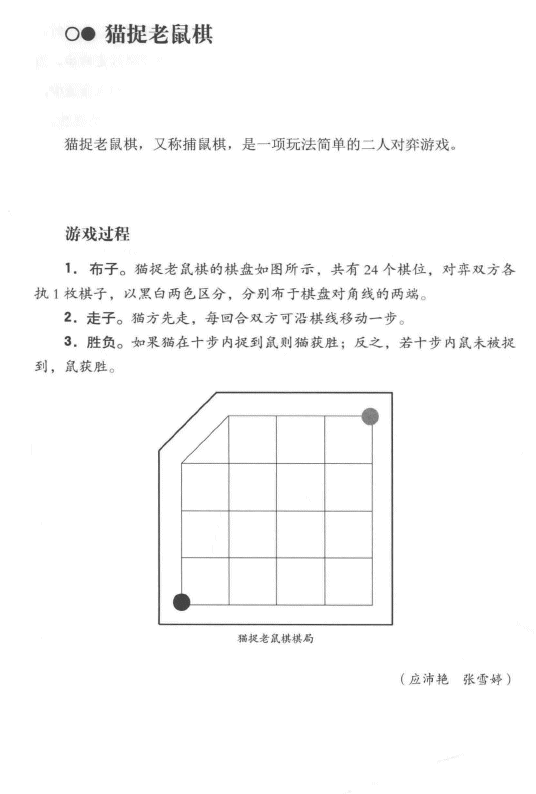
Cat Catches the Mouse Chess, also called Mouse-Catching Chess,
is a very simple two-player abstract strategy game.

Game Procedure

Setup

The board for Cat Catches the Mouse Chess is shown in the diagram. It has
24 intersections. Each player has one piece, distinguished by black and white,
and they are placed on the two opposite corners of the board.

Moves

The cat moves first. On each turn, either player may move their piece one step
along the lines.

Winning Condition

If the cat catches the mouse within ten moves, the cat wins. Otherwise, if
after ten moves the mouse has not been caught, the mouse wins.

(Diagram caption: “Cat Catches the Mouse Chess Board”)

(Ying Shipo, Zhang Xuelin)
This seems a broken game (the mouse just needs to move between two non-corner edges) that might be interesting for young children.
Mingyang Tian: This is indeed a children's game, and quite popular. The key point is: cat should go along that diagonal corner once. The reason will be clear if you play it on a checker board.
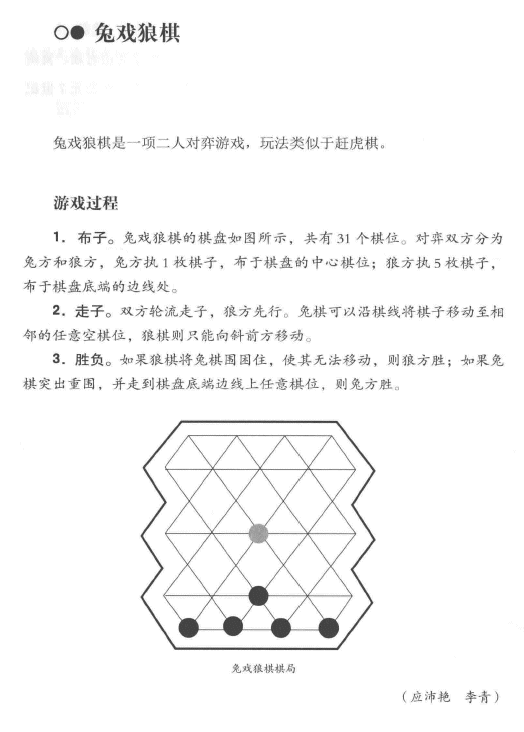
Hare and Wolf Chess is a two-player abstract strategy game.
Its gameplay is similar to Hounds and Hare (or Hare and Hounds).

Game Procedure

Setup

The board for Hare and Wolf Chess is shown in the diagram and has
31 intersections. The two sides are the hare and the wolves.

The hare has 1 piece, placed on the central intersection of the board.

The wolves have 5 pieces, placed on the five intersections along the
bottom edge of the board.

Moves

The wolves move first.
The hare may move along the lines to any adjacent intersection.
The wolves may only move forward along the lines.

Winning Conditions

If the wolves surround the hare so that it cannot move, the wolves win.

If the hare breaks through the encirclement and moves first to the
bottom edge of the board, the hare wins.

(Diagram caption: “Hare and Wolf Chess Board”)

(Ying Shipo, Li Chun)
This is a Hare and Hounds variant.
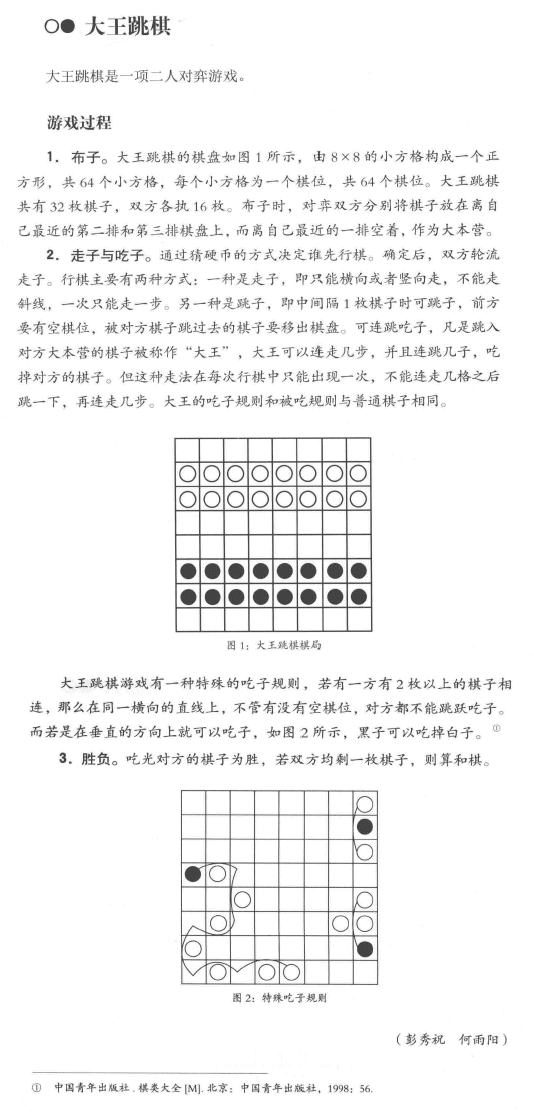
King Jump Chess is a two-player abstract strategy game.

Game Procedure

Setup

The board for King Jump Chess is shown in Figure 1. It is a square formed by an
8 × 8 grid, with 64 squares, each square being an intersection point.

There are 32 pieces in total, 16 per player. During setup, each player places
their pieces on the second and third ranks closest to themselves, leaving the
first rank nearest to each player empty, which serves as that player’s home
camp.

Moves and Capturing

The first player is determined by drawing lots. Once decided, players
alternate turns.

Non-capturing move: A piece may move one step forward or diagonally forward,
but may not move sideways or backward. Only one move per turn is allowed.

Capturing move: A piece may capture by jumping. As shown in Figure 1, when
capturing, there must be an opponent piece directly adjacent in front, and the
jumping piece moves to the square beyond it, which must be empty. The jumped
piece is removed from the board.

A piece that jumps into the opponent’s home camp is promoted to a “King”.
A King may move one step and may also make multiple consecutive jumps,
capturing several pieces in succession. After each jump, if another capture is
possible, the King must continue jumping. The jumping and capturing rules for
the King are the same as in Checkers.

Special capturing rule:

If one side has two or more adjacent pieces in a straight horizontal line, then
regardless of whether there are empty squares, the opponent may not capture by
jumping along that horizontal line.

However, capturing is allowed along vertical or diagonal directions.
As shown in Figure 2, the black pieces may capture the white pieces.

Winning Conditions

The player who captures all of the opponent’s pieces wins.
If each side is reduced to only one piece, the game is a draw.

(Figure 1: King Jump Chess Setup)
(Figure 2: Special Capturing Rule)

(Peng Xihe, He Yumin)
Moving/jumping direction: Orthogonally only, retreating is allowed.
(The LLM made a weird mistake here. Maybe use a traditional machine-translating.)

Special capturing rule:

If you have 2 pieces orthogonally adjacent to each other, all friendly pieces
on that line cannot be captured parallel-ly to those 2 pieces, but can be
captured vertically.

Not allowed:

    OX.XX  =>  ..OXX

Allowed:

    .O.      ...
    XX.  =>  X..
    ...      .O.

King: Move like a non-capture Rook. After movement, it can make an additional
normal jump-capture. This jump cannot be multipled.
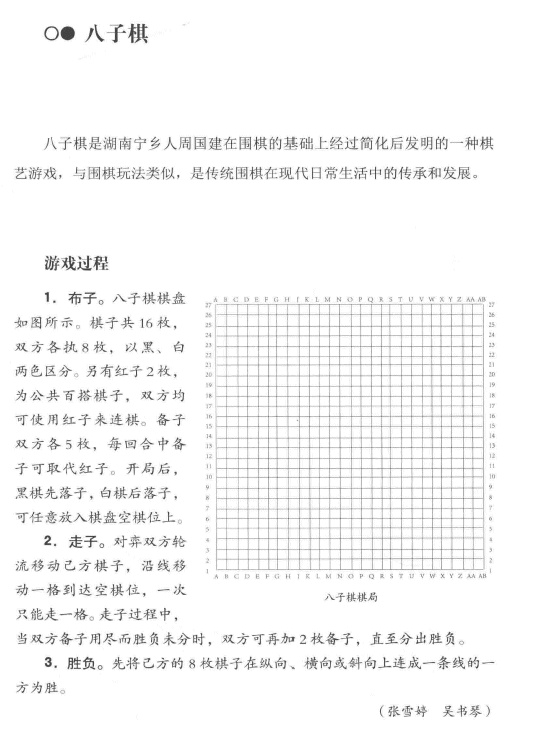
The book seems to mix the descriptions of two different games.

Mingyang Tian:
    I searched for Zhou Guojian. According to a news report, this person invented 八子棋
    in 2001, which uses 4*5 board and 8 stones. Unfortunately, I can't find a detailed
    rule of this version. But the text is in the book very similar to a game (of the
    same name) developed by the Chinese community, maybe around 2017. I believe the
    author(s) had made some mistakes when collecting information.

    This game was invented long before I joined the community, and I never played it.
    I asked others for comment, and one replied that the idea of this game is novel,
    but the game-experience is not fun.

Connect-8 (八子棋)

Designer: 信此名有人用(Nickname)

Materials: 27*27 square board, sufficient black, white and red stones, 10 tokens.

Setup:
    Black starts. Black drops two stones, then White drops three stones.
    Each player got five tokens.

Gameplay:
    On each turn, the player either:
       Drops two own stones and one red stone,
       Spend a token, then drop three own stones.
    When both players used up their tokens, each player receives two more tokens.

Goal:
    Form an 8-in-a-row (orthogonal or diagonal) which may include any red stones.
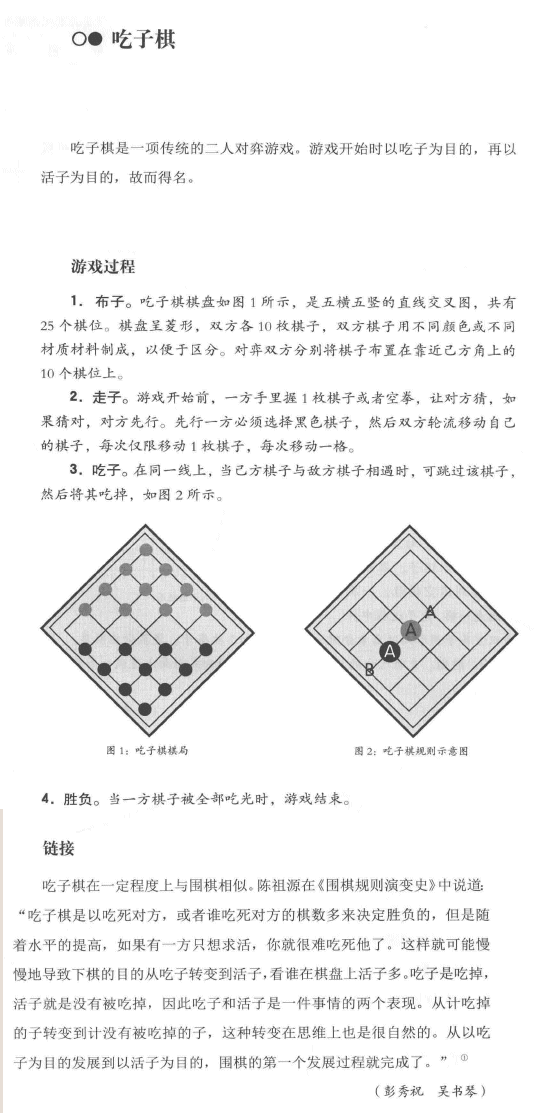
Capture Chess is a traditional two-player confrontation game. At the beginning
of the game, the objective is to capture pieces; survival then becomes the
objective, hence the name of the game.

Game Procedure

1. Setup

The Capture Chess board is shown in Figure 1. It consists of the intersections
of five horizontal and five vertical straight lines, for a total of 25 points.
The board is square in shape.

Each player has 10 pieces. The pieces of the two players are made of different
colors or different materials so that they can be distinguished.

Before the game begins, each player places their 10 pieces on the 10 points
closest to their own side of the board.

2. Movement

Before the game starts, one player holds 1 piece or an empty hand and
challenges the opponent. If the opponent guesses correctly, the opponent
moves first.

The player who moves first must choose a piece color. Thereafter, the two sides
alternately move their own pieces. Each turn, a player may move only one piece,
and each move consists of one step.

3. Capturing

After one side moves a piece, if that piece encounters an opponent’s piece, it
may jump over that piece and capture it. The captured piece is then removed
from the board, as shown in Figure 2.

4. Victory and Defeat

The game ends when one side’s pieces have all been captured.

Discussion

Capture Chess is similar to Go to a certain extent. Chen Zhiyuan notes in
A History of the Evolution of Go Rules:

“Capture Chess determines victory and defeat by killing the opponent or by
counting the number of pieces killed. However, as skill levels rise, if one
side only seeks survival, it becomes very difficult to kill them. This can
gradually cause the objective of play to shift from capturing pieces to living.
In that case, living on the board becomes increasingly important. Capture Chess
emphasizes capturing, while living without being captured is also a form of
capturing; thus, capturing and living are two aspects of the same thing. The
transition from focusing on captured pieces to focusing on pieces that cannot
be captured is a natural one in terms of logic. From Capture Chess, with
capturing as the objective, to Go, with living as the objective, the first
stage of Go’s development is thus completed.”

(Peng Xiangrui · Wu Ziyao)
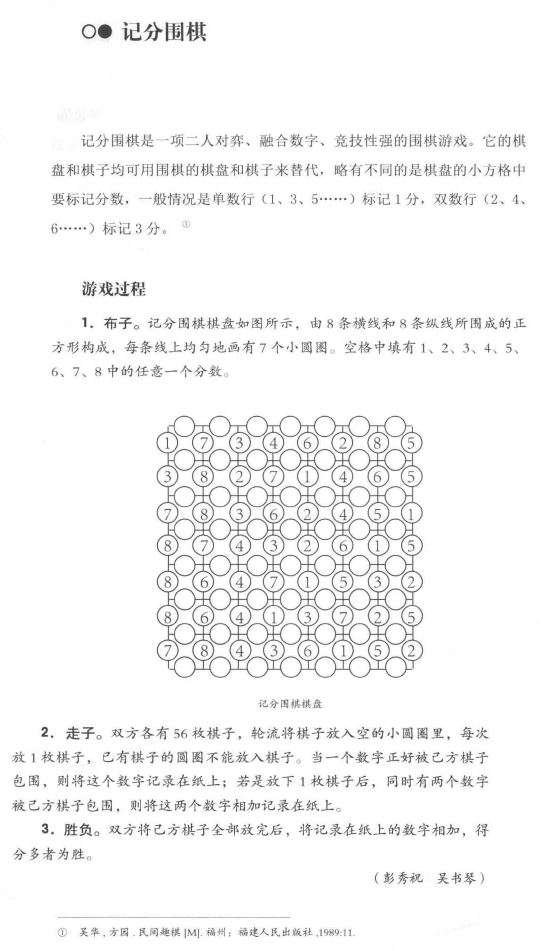
Scoring Go is a two-player confrontation game that combines numbers and
competition and is a variant of Go with a strong competitive character. Both
the board and the pieces may be replaced by those of Go. The main difference is
that the small grid points on the board are marked with scores. Generally,
odd-numbered rows (1, 3, 5, …) are marked with 1 point, while even-numbered
rows (2, 4, 6, …) are marked with 3 points. ①

Game Procedure

1. Setup

The Scoring Go board is shown in the figure. It is a square board formed
by 8 horizontal lines and 8 vertical lines, producing a grid of intersections.
Each line contains 7 small circles.

Each empty circle is filled with a number—1, 2, 3, 4, 5, 6, 7, or
8—representing a score value.

2. Play

Each side has 56 pieces. Players take turns placing one piece at a time,
placing it on an empty small circle.

After a piece is placed, if that piece encloses an area of empty circles,
the numbers in those enclosed circles are recorded.

If one piece is placed and, at the same time, two numbers are enclosed by
that player’s pieces, then the two numbers are added together and recorded.

3. Victory and Defeat

When all of one player’s pieces have been placed, the numbers recorded on
that player’s score sheet are added together. The player with the higher
total score wins.

(Peng Xiangrui · Wu Ziyao)

Reference

① Wu Jun, Fang Yuan. Collection of Go Variants [M].
  Fuzhou: Fujian People’s Publishing House, 1989, p. 11.
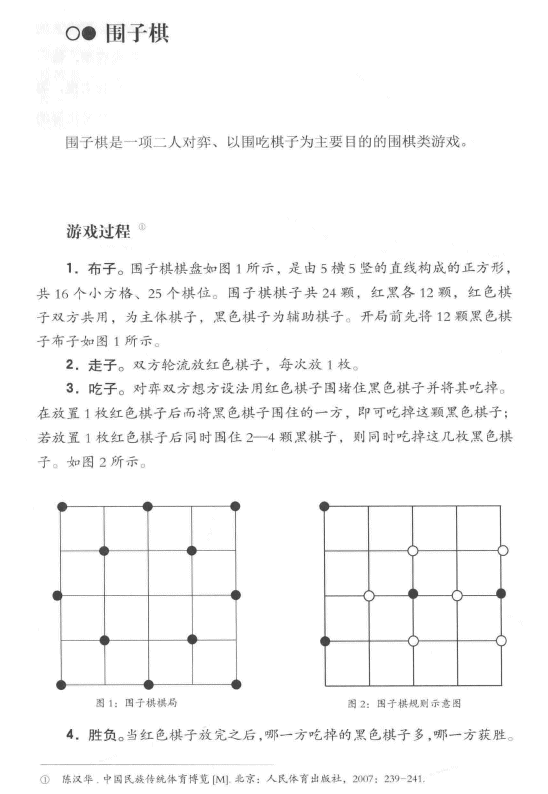
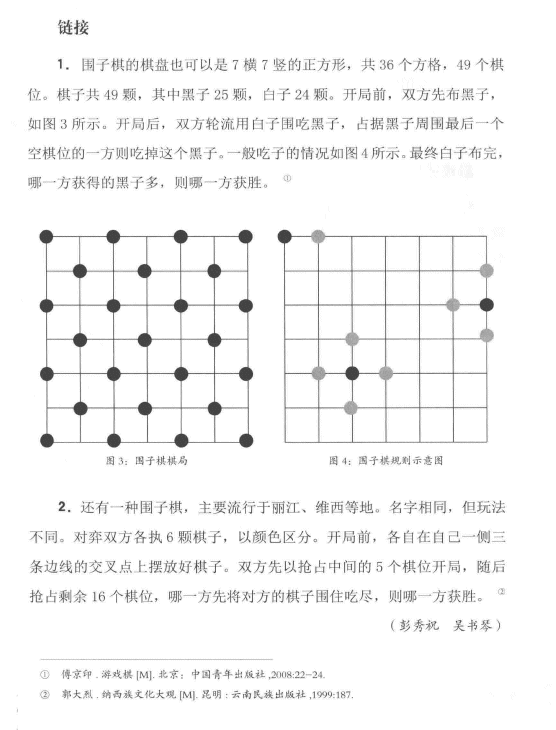
Enclosure Chess is a two-player confrontation game and a Go-type board
game whose main objective is to capture pieces.

Game Procedure

1. Setup

The Enclosure Chess board is shown in Figure 1. It is a square formed
by 5 horizontal and 5 vertical straight lines, producing 16 small squares
and 25 intersections.

There are 24 pieces in total: 12 red and 12 black. The red pieces are shared by
both players and serve as the main pieces, while the black pieces are the
auxiliary pieces.

Before the game begins, the 12 black pieces are first placed on the board as
shown in Figure 1.

2. Play

The two players alternately place red pieces, placing one piece per turn.

3. Capturing

After the two players have placed red pieces alternately, either player
may use red pieces to surround black pieces and capture them.

After one red piece is placed, if a black piece is completely surrounded
by red pieces, it is captured and removed.

If, after one red piece is placed, two to four black pieces are surrounded,
then those two to four black pieces are captured simultaneously, as shown
in Figure 2.

4. Victory and Defeat

After all red pieces have been placed, the player who has captured more
black pieces wins.

① Chen Hanping. Chinese Folk Chess and Board Games [M].
  Beijing: People’s Sports Publishing House, 2007, pp. 239–241.

Variants and Related Games

1.

The Enclosure Chess board may also be a square of 7 horizontal and 7 vertical
lines, producing 36 small squares and 49 intersections. There are 49 pieces
in total, of which 25 are black and 24 are white.

Before the game begins, both players first place black pieces, as shown in
Figure 3. After setup, the two players alternately place white pieces to
surround black pieces. The player who occupies the last remaining empty
intersection around a black piece captures that black piece.

Typical captures are shown in Figure 4. After all white pieces have been
placed, the player who has captured more black pieces wins.

2.

There is another type of Enclosure Chess, mainly popular in Zhejiang and
Yunnan. It has the same name but different rules.

Each player has 6 pieces, distinguished by color. Before the game begins,
each player places their pieces on the intersections of three horizontal
lines on their own side.

The two players begin by competing for the 5 intersections in the center
of the board. They then contest the remaining 16 intersections. The first
player to completely surround the opponent’s pieces and capture them wins.

(Peng Xiangrui · Wu Ziyao)
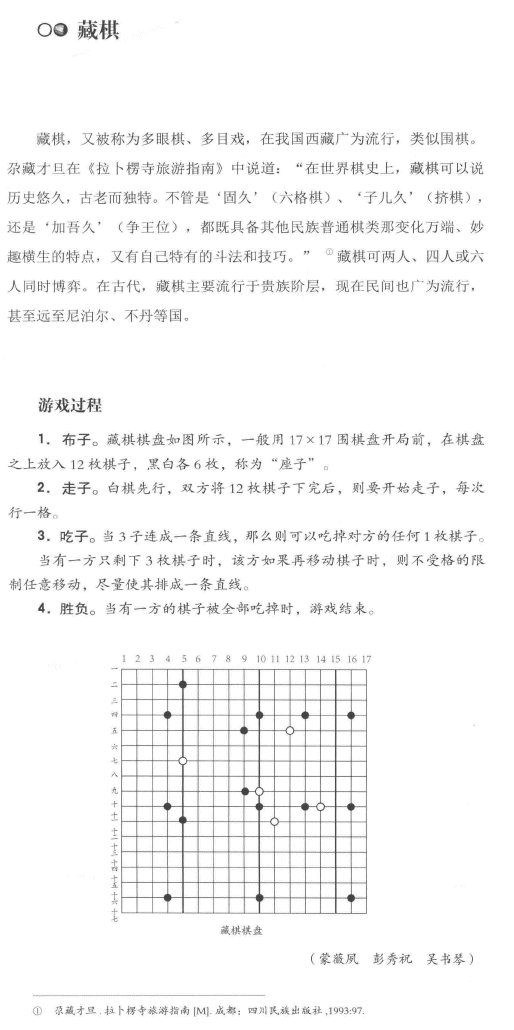
Zang Chess, also known as Many-Eye Chess (多眼棋) or Multi-Eye Chess (多目棋),
is popular in western China and is a Go-type board game.

Zongzang Zhaba notes in A Guide to Tibetan Travel:

“In world chess history, Zang Chess can be said to be ancient and unique.
Whether compared with ‘Tianjiu’ (Six-Piece Chess), ‘Geziluo’ (Cross Chess), or
‘Jiajiajiu’ (Hand-Position Chess), it both absorbs the cultural essence of
other ethnic groups’ chess traditions—simple, ingenious, and interesting—and
also possesses its own distinctive methods and techniques.”

Zang Chess can be played by two, four, or six players simultaneously. In
ancient times it was mainly popular among the aristocracy; today it is commonly
played among the general population, and is especially widespread in Tibet,
Nepal, and Bhutan.

Game Procedure

1. Setup

The Zang Chess board is shown in the figure. It is generally a 17 × 17 Go board.

Before the game begins, 12 pieces are placed on the board, with 6 black
and 6 white. These are called the “base pieces” (座子).

2. Movement

White moves first. After both sides have placed the 12 pieces, normal movement
begins. Each move consists of one step.

3. Capturing

When three pieces form a straight line, the player may capture any one of
the opponent’s pieces.

When one side has only 3 pieces remaining, that side may ignore the one-step
movement restriction and move pieces freely, as long as the player tries to
arrange them into a straight line.

4. Victory and Defeat

The game ends when one side’s pieces have all been captured.

(Meng Fanwei · Peng Xiangrui · Wu Ziyao)

Reference

① Zang Chess, in Guide to Tibetan Travel [M].
  Chengdu: Sichuan People’s Publishing House, 1993, p. 97.
Zang Chess (藏棋)

藏棋 means "Tibetian Game", and can be refered to many different abstract
games origined in Tibetian. And it seems the author mixed them again.

The "17*17 board with 12 initial stones" one is Tibetian Go. The rules
can be easily found on the Internet.

I cannot find a "3-in-a-row" one. But I guess it would be a variant
of 9-men-morris.

Another famous tibetian game is Jiu Qi (久棋):
  https://boardgamegeek.com/thread/1814455/which-tibetan-game-is-this
.gif)
Dúzǐqí is a two-player abstract strategy game. Its greatest distinguishing
feature is that on a fairly large board there is only a single piece, hence the
name. The rules are simple, yet the game is full of subtlety. In playing
Dúzǐqí, although the piece has many possible paths of advance, all routes are
of equal length—that is, the total number of steps from the starting point to
the ending point is fixed. Moreover, if on the first move one does not play
well, this will influence the overall outcome of the entire game. Therefore, in
every encounter both sides tend to be extremely cautious, carefully calculating
and comparing possibilities.

Game Procedure

1. Setup

The board of Dúzǐqí is as shown in the diagram, formed by straight lines
intersecting diagonally and vertically. The board contains many squares and
many intersection points. By agreement of both players, either square-based
placement or point-based placement may be used.

Point-based placement may also be used. There is only one piece, shared by both
players; any easily obtained object may serve as the piece—such as a stone, a
blade of grass, or a twig—though a round piece is preferable. During setup,
place the single piece on a square at one corner of the board.

(Diagram caption: “Dúzǐqí board”)

2. Movement

The two players take turns moving. On each turn, a player may move one step, or
may consecutively move two steps. Movement is only allowed forward; moving
backward is not permitted. If two steps are taken, a turn may be made in the
middle.

The square where the piece is located at the start of the game is the starting
point, and the vertex at the opposite corner of the board is the destination.

3. Victory

During play, the position of the piece changes, but there is always only one
piece. Once the piece reaches the destination, the game ends, and the player
who moved the piece to the destination is the winner.

(Xu Bin, He Hejian)

From: Zhou Wei (ed.), One Hundred Abstract Games,
      Beijing: People’s Sports Publishing House, 2009, p. 56.
This game can be easily solved with memoization.
Here is the value of each position (left-bottom is the starting position):
                v
1 1 0 1 1 0 1 1 0 <- final corner
0 1 1 0 1 1 0 1 1
1 0 1 1 0 1 1 0 1
1 1 0 1 1 0 1 1 0
0 1 1 0 1 1 0 1 1
1 0 1 1 0 1 1 0 1
1 1 0 1 1 0 1 1 0
0 1 1 0 1 1 0 1 1
1 0 1 1 0 1 1 0 1    Note that 1 means win for the next player, 0 means loss.
Depending on the board size, there is a pattern of repeating (loss, win, win) for the first player. That is, with perfect play, the first player wins for boards of size N when N mod 3 ≠ 1.
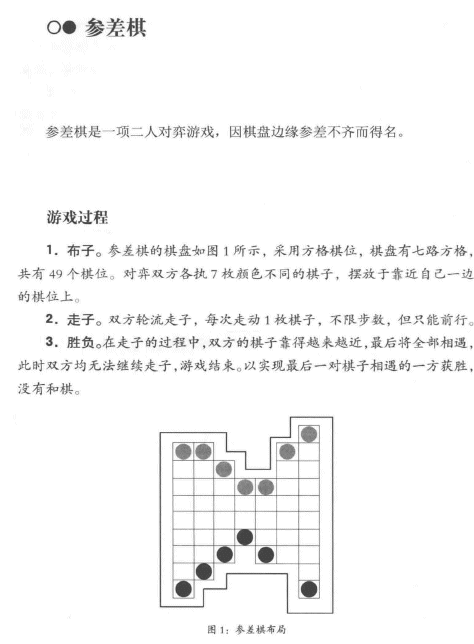
Uneven Chess is a two-player abstract game. It takes its name from the uneven
outline of the board.

Game Procedure

1. Setup

The Uneven Chess board is shown in Figure 1. It uses square intersections; the
board has seven squares per side, for a total of 49 intersections.

Each player has 7 pieces of a different color. During setup, the players place
their pieces on the intersections closest to their own side of the board.

2. Movement

The two players alternate turns. On each turn, a player moves one piece. The
number of steps is not limited, but the piece may only move straight forward.

3. Victory and Defeat

Capturing is not permitted in this game.

The player who is the first to move all of their pieces to the opponent’s side
of the board wins.

If a player is blocked and unable to move all of their pieces, the opponent
wins. There are no draws.

Related Game

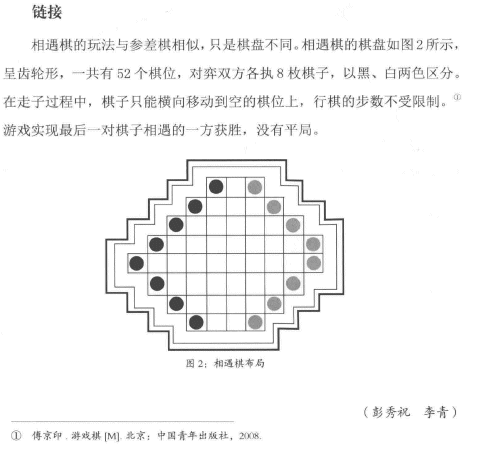
Mutual-Approach Chess (相遇棋)

The rules of Mutual-Approach Chess are similar to those of Uneven Chess; only
the board differs.

The Mutual-Approach Chess board is shown in Figure 2. It has a stepped outline
and contains 52 intersections. Each player has 8 pieces, distinguished as black
and white.

During play, pieces may move only to adjacent intersections, but the number of
steps per move is not limited.

The game ends when the final pair of opposing pieces meet; the player whose
piece reaches the meeting point first wins. There are no draws.

(Peng Xiangrui · Li Yu)
Uneven Chess (参差棋)

The movement rule translated by LLM is correct. Pieces can only be
moved forwardly, so in the end all pieces will block each other.
The player who makes the last legal move wins.
(So it's Nim, but played on a "2-dimensional" board)
This game is also known as Tiouk Tiouk, a West African game, or more recently as Northcott's game.
Another NIM-like game, from Folk Board Games (民间棋类游戏) by Luo Jianjiang (罗鉴江 编著) is the following:
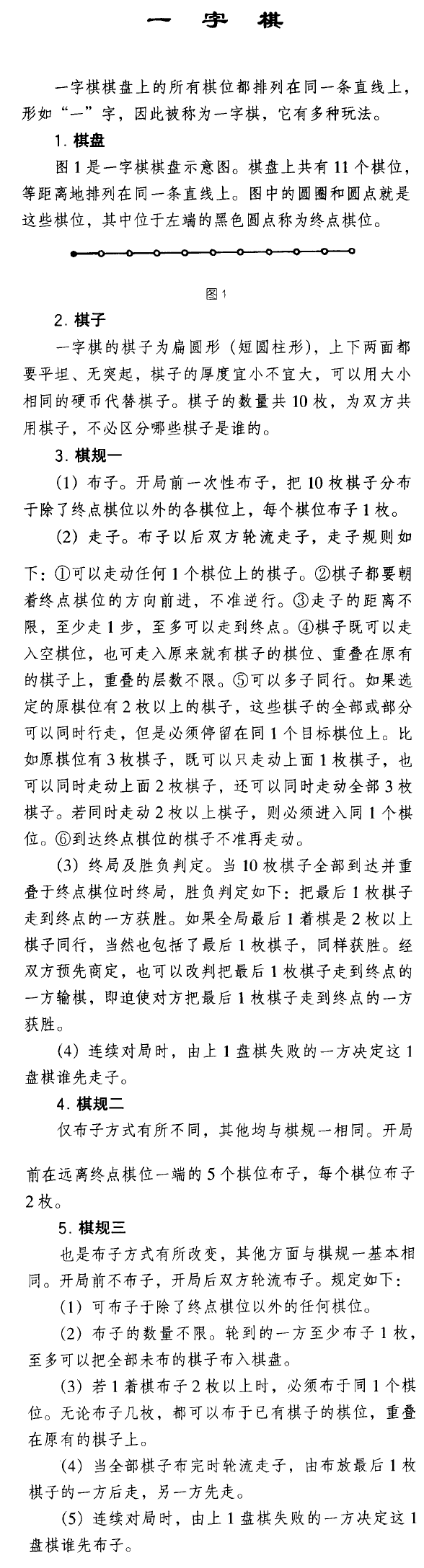
One-Line Chess (一字棋)

All positions on the One-Line Chess board are arranged along a single straight
line, shaped like the character “一” (a horizontal stroke). Hence it is called
One-Line Chess. The game has multiple variants.

1. The Board

Figure 1 shows the One-Line Chess board.
There are 11 positions on the board, evenly spaced along a single straight
line. The solid circles and hollow circles in the diagram represent these
positions. The black solid circle at the left end is called the end position.

2. Pieces

The pieces are flat discs (short cylindrical shape), with both the top and
bottom surfaces flat and without protrusions. The thickness should be
moderate—neither too thick nor too thin. Coins of the same size may be used
as substitutes.

There are 10 pieces in total, shared by both players. Pieces are not assigned
to specific players.

3. Rules I
(1) Placement

Before the game begins, pieces are placed once only.
All 10 pieces are placed on all positions except the end position, with
one piece per position.

(2) Movement

After placement, players take turns moving. The movement rules are as follows:

Any piece on any position may be moved.

All pieces must move toward the end position and may not move backward.

The movement distance is unrestricted: at least one step, and at most up to
the end position.

A piece may move into an empty position, or onto a position already occupied
by pieces, stacking on top of them. There is no limit to the number of stacked
layers.

Multiple pieces may move simultaneously.
If the chosen starting position contains two or more pieces, all or some of
them may move at the same time, but they must end on the same target position.
For example, if a position contains three pieces, you may move only the top
piece, or the top two pieces together, or all three pieces together.

If two or more pieces move together, they must move to the same destination.

Pieces that have reached the end position may no longer be moved.

(3) End of Game and Victory Conditions

The game ends when all 10 pieces have reached and are stacked on the end
position. Victory is determined as follows:

The side that moves the last piece to the end position wins.

If, on the final move, two or more pieces move together
(including the last piece), that side also wins.

By prior agreement, the players may alternatively decide that the side
who forces the opponent to move the final piece to the end position wins
instead.

(4) Consecutive Games

In a series of games, the player who lost the previous game decides who
moves first in the next game.

4. Rules II

Only the placement method differs; all other rules are the same as in Rules I.

Before the game begins, pieces are placed on the five positions farthest
from the end position, with two pieces on each position.

5. Rules III

Again, only the placement method is changed; other aspects are basically
the same as in Rules I.

Before the game begins, no pieces are placed. After the game starts,
players take turns placing pieces, with the following rules:

Pieces may be placed on any position except the end position.

There is no limit to the number of pieces placed per turn. On a
player’s turn, they must place at least one piece, and may place
all remaining unplaced pieces.

If two or more pieces are placed in a single turn, they must be placed
on the same position.

Any number of pieces may be placed on a position that already contains
pieces, stacking without limit.

When all pieces have been placed, players then take turns moving pieces.
The player who placed the last piece moves first, and the other player moves second.

In consecutive games, the player who lost the previous game decides who
places first in the next game.
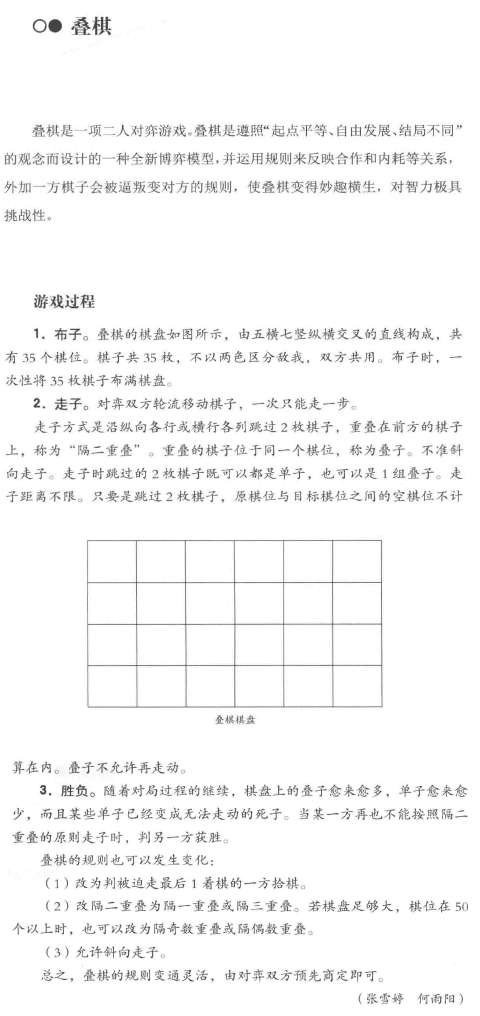
Stack Chess is a two-player abstract game. It is a completely new chess model
designed according to the ideas of “equal starting positions, free development,
and non-fixed outcomes.” It uses rules to reflect cooperation and constraints.
On the surface, pieces are continually captured or removed according to the
opponent’s rules, but in reality the game emphasizes stacking mechanics and
presents a very high level of intellectual challenge.

Game Overview

Stack Chess is a two-player game based on a "fair start, free development, but
different outcomes" philosophy. The core mechanic involves jumping over pieces
to create "stacks." Once a piece becomes part of a stack, it is locked and
cannot move again.

Game Process

1. Setup (布子)

    The Board: A grid of 5 horizontal lines and 7 vertical lines, creating 35
    intersection points (positions).

    The Pieces: There are 35 identical pieces. Unlike traditional chess, pieces
    are not divided by color to represent sides; they are shared by both
    players.

    Initial State: At the start, all 35 pieces are placed on the board, filling
    every intersection.

2. Movement (走子)

Players take turns moving any single piece according to these rules:

    The "Jump Two" Rule: A piece moves vertically or horizontally by jumping
    over exactly two pieces and landing on the third piece to form a Stack
    (叠子).

    Direction: Movement must be in a straight line (no diagonals).

    The Jump: The two "jumped" pieces can be single pieces or already-formed
    stacks.

    Distance: The physical distance is irrelevant. As long as you jump over
    exactly two occupied positions, the empty spaces between them do not count.

    Stacking Limit: Once a piece has been stacked onto another, it cannot be
    moved again.

3. Winning and Losing (胜负)

    As the game progresses, single pieces become fewer and stacks become more
    frequent. Eventually, some pieces become "dead" because they cannot make a
    valid jump.

    Victory: The game ends when a player cannot make a move according to the
    "Jump Two" rule. In the standard rules, the player who cannot move loses,
    and their opponent is declared the winner.
Stack Chess (叠棋)

Gameplay: picks one stone and orthogonally jumps over exactly two other
stones (no need to be adjacent; a stack count as the number of stones it
contains, so in other words, you can jump over either 2 single stones or
a 2-stone stack), landing on top of a third stone to form a stack.
Stacks cannot move.
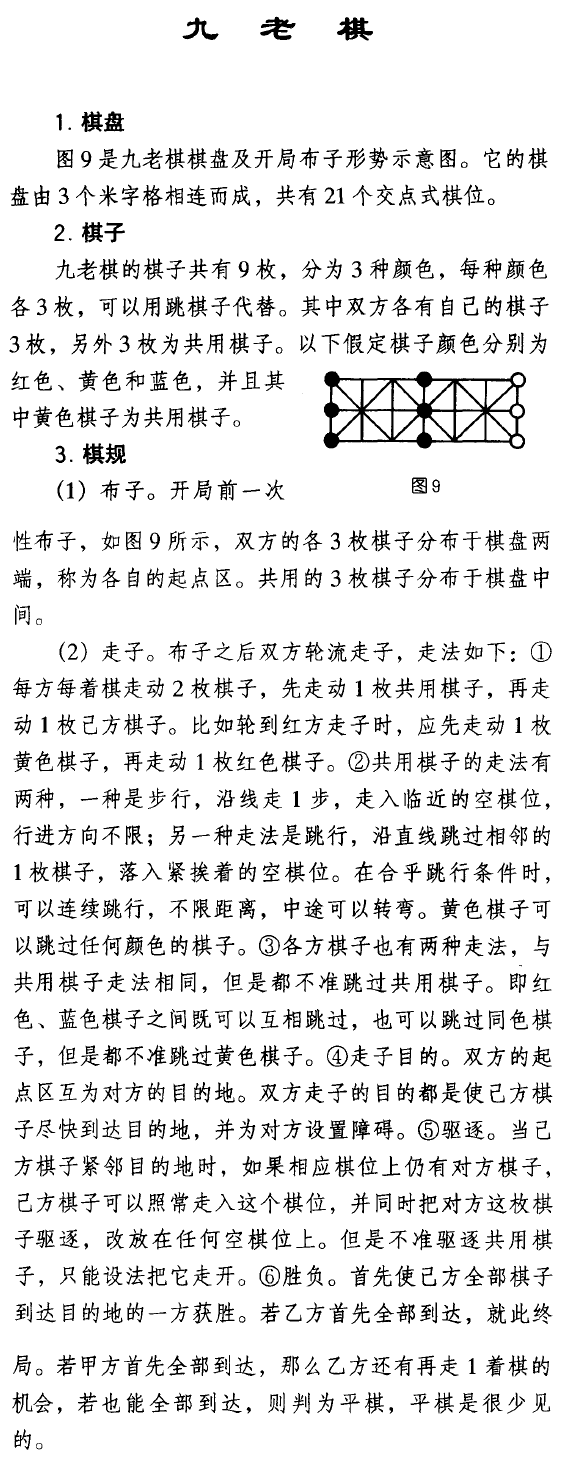
Nine Elders Chess (九老棋)

1. The Board

Figure 9 shows the Nine Elders Chess board and the initial placement.
The board is composed of three connected “rice-character” grids (米字格),
for a total of 21 intersection points that serve as playing positions.

2. Pieces

There are 9 pieces in total, divided into three colors, with three pieces
of each color. Go stones may be used as substitutes.

Each player has three personal pieces, and the remaining three pieces are
shared pieces. In the following description, the three colors are assumed
to be red, yellow, and blue, with the yellow pieces being the shared pieces.

3. Rules
(1) Placement

Before the game begins, pieces are placed once only.

As shown in Figure 9, each player’s three personal pieces are placed at
opposite ends of the board, forming their respective starting areas.

The three shared pieces are placed in the center of the board.

(2) Movement

After placement, players take turns moving, with the following rules:

On each turn, a player moves two pieces: first one shared piece,
then one of their own pieces.

For example, when it is Red’s turn, Red must first move one yellow
(shared) piece, and then move one red piece.

Shared pieces have two kinds of moves:

Step move: move one step along a line to an adjacent empty position,
with no restriction on direction.

Jump move: jump along a straight line over one adjacent piece, landing
on the immediately adjacent empty position beyond it.

When jump conditions are satisfied, multiple jumps may be made consecutively,
with no limit on distance, and the path may change direction mid-way.

Yellow pieces may jump over pieces of any color.

Each player’s own pieces also have two kinds of moves, the same as the
shared pieces, but they may not jump over shared pieces.

That is, red and blue pieces may jump over each other or over pieces of
the same color, but may not jump over yellow pieces.

Objective of movement:

Each player’s starting area is the opponent’s target area.

The goal of both players is to move their own pieces to the target area
as quickly as possible, while setting obstacles for the opponent.

Driving off (displacement):
When one of a player’s pieces reaches a position adjacent to the target area,
if the corresponding target position is occupied by an opponent’s piece, the
player may move into that position as usual and simultaneously drive off the
opponent’s piece, relocating it to any empty position on the board.

Shared pieces may not be driven off; they can only be blocked.

Victory and defeat:

The first side to get all of their own pieces into the target area wins.

If the second player reaches the target area with all pieces first, the game
ends immediately.

If the first player reaches the target area with all pieces first, the second
player is still allowed one final move; if the second player can also get all
of their pieces into the target area, the result is a draw.

Draws are very rare.
Interesting Halma-like game using neutral pieces.
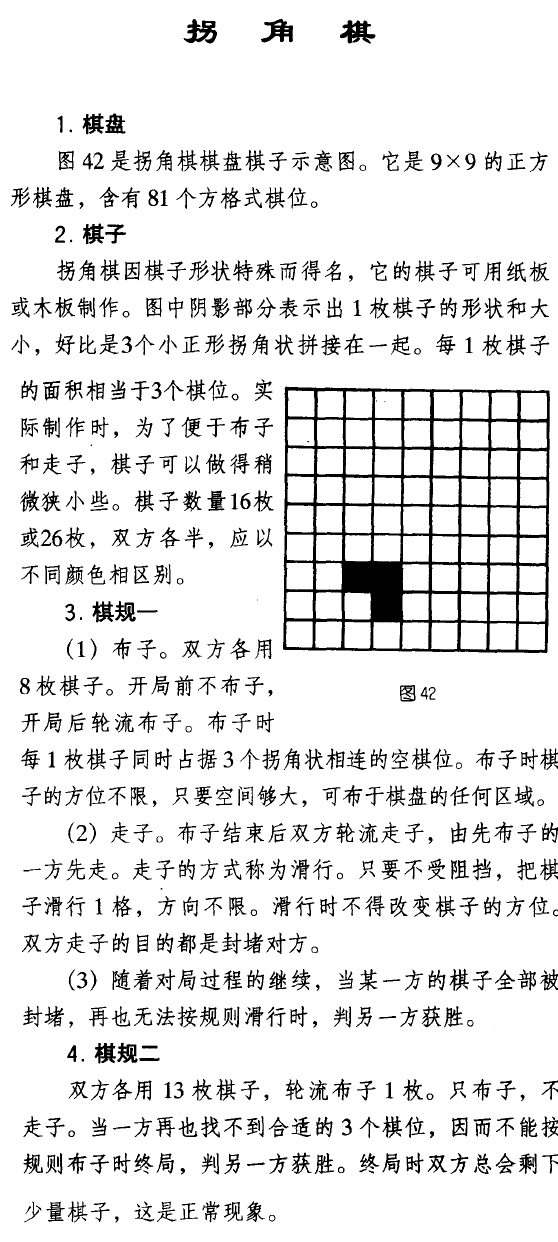
L-Corner Chess (拐角棋)
1. The Board

Figure 42 shows the L-Corner Chess board and pieces.
The board is a 9×9 square grid, containing 81 square positions.

2. Pieces

L-Corner Chess is named for the special shape of its pieces.
The pieces may be made from cardboard or wood.

In the diagram, the shaded area shows the shape and size of a single piece: it is like
three small square L-shapes joined together.

Each piece covers an area equivalent to three board squares.

In actual play, for convenience of placement and movement, the pieces may be made
slightly smaller.

The number of pieces is 16 or 26, divided equally between the two players, and
distinguished by different colors.

3. Rules I
(1) Placement

Each player uses 8 pieces.
No pieces are placed before the game begins. After the game starts, players take
turns placing pieces.

Each piece occupies three empty squares connected in an L-shape.
There is no restriction on placement location; as long as space permits, pieces may
be placed anywhere on the board.

(2) Movement

After placement is complete, players take turns moving pieces, with the player who
placed first moving first.

The movement method is called sliding: as long as a piece is not blocked, it may be
slid by one square in any direction. During sliding, the orientation of the piece
may not change.

Both players’ objective in moving is to block the opponent.

(3) End of Game and Victory Conditions

As the game progresses, when all pieces of one side become completely blocked and can
no longer slide legally, that side loses and the other side wins.

4. Rules II

Each player uses 13 pieces, and players take turns placing one piece per turn.
Only placement is allowed; pieces are not moved.

When one side can no longer find three suitable empty squares to place a piece according
to the rules, the game ends and the other side wins.

At the end of the game, both sides will usually have a small number of unused pieces
remaining; this is considered normal.
This reminds of the L-game, but with a better, workable design.

Mushroom Chess (蘑菇棋)

1. The Board

Figure 66 shows the Mushroom Chess board.

The board is an irregular hexagon.
On the board are 48 mushroom-shaped positions, which may be regarded
as 48 intersections.

These intersections are arranged in 8 rows of unequal length.
The longest row has 8 intersections, and the shortest row has 4 intersections.

2. Pieces

The pieces of Mushroom Chess are mushroom-shaped, with a rod-like stem at the
bottom, allowing them to be fixed upright on the intersections.

There are 48 pieces in total, equal in number to the intersections, divided
into two colors, 24 pieces per side.

3. Rules I
(1) Placement

Before the game begins, pieces are placed once, as shown in Figure 13.
Red and green pieces are placed alternately, 4 pieces per player.

(2) Capture

After placement, players take turns capturing pieces.

① Only adjacent pieces may be captured.
② The number of pieces captured each time is not fixed: at least 1 piece
  must be captured, and up to 8 pieces may be captured.
③ If the number of pieces captured is even, then all captured pieces must
  be of the same color.
④ If the number of pieces captured is odd, then the captured pieces must
  include both colors, and they must be taken from adjacent intersections
  of different colors.
⑤ Pieces that are completely surrounded may not be captured.
⑥ Pieces located along the edge may not capture pieces toward their own side.
  The purpose of capturing is to reduce the total number of pieces on the board.

(3) Victory

When all pieces on the board have been captured, the game ends.
The player who captures the last piece wins.

If both players capture their final piece simultaneously, then victory is
awarded to the player who first captured the opponent’s last piece.

A variant rule may also be used: the player who forces the opponent to capture
the final piece loses.

4. Rules II

There is no restriction on the total number of pieces captured, and no
restriction on color.

Other rules are the same as in Rules I, except:

During capture, if a player cannot capture, they skip their turn.

When both players are unable to capture for an extended time, sliding moves
may be used instead.

5. Rules III

(1) Placement

Before the game begins, pieces are placed once.
All pieces are placed fully on the board, and colors may be mixed freely.

(2) Capture

After placement, players take turns capturing.

① Each capture must take exactly 1 piece.
② For each capture, two dice are rolled.

The first die indicates the minimum number of pieces connected to the captured
piece, and this number must be at least 3.

The second die indicates the number of intersections connected to the captured
piece. If the second number is greater than the first, the capture is valid.

Example:

  If there are 5 connected intersections, and the dice show 4, then the capture
  is valid.

  If there are 4 connected intersections, and the dice show 3, then the capture
  is also valid. However, if the dice show 4 but only 3 intersections are connected,
  the capture is not allowed.

(3) Victory

As the game proceeds, when one player can no longer capture according to Rules I–II,
the game ends and the other player wins.

6. Rules IV

(1) Placement

No pieces are placed before the game begins.
After the game starts, players take turns placing pieces.

① Each player places 3 pieces per turn.
② Pieces must be placed on three adjacent intersections forming a triangle.

(2) Victory

As the game proceeds, when one player can no longer place pieces according to
the rules, the other player wins.

7. Rules V
(1) Placement

Each player uses 9 pieces, one side red and the other green.
All other pieces are not used.

Before the game begins, pieces are placed once.
As shown in Figure 66, pieces are placed on 6 rows of the board, with 3 empty
intersections left at each end of every row.

Each player places 5 pieces, with 4 of them placed on the central 4 intersections
of each row, leaving 2 empty intersections between them.

The 9 pieces together form a hexagonal pattern.

(2) Movement

After placement, players take turns moving pieces.
Movement is similar to standard board games.

① Pieces move one step at a time, in any direction, or may jump.
② Continuous moves are allowed: after one move, if further moves are possible,
  the piece may continue moving. Direction is unrestricted, but no position
  may be visited twice.
③ Capturing: the piece that moves last captures the opponent’s piece it lands on.

(3) Victory

When a player’s pieces form a hexagonal pattern around 9 intersections, that
player wins.

Alternatively, if one player forms a complete enclosure around the opponent’s
pieces, that player wins.

If neither side can achieve a win condition, the game is a draw.

8. Rules VI

(1) Placement

Each player uses pieces of different colors.
No pieces are placed before the game begins.
After the game starts, players take turns placing pieces, one per turn.

① After placement, sliding movement is used.
Pieces may slide to adjacent intersections.
The board intersections are divided into four zones, numbered 4, 3, 2, and 1.

The 21 intersections around the board edge form 4 rings:

The outer ring has 3 intersections, followed by 5 intersections,
then 7 intersections, and the innermost ring has 9 intersections.

Within the central region, 3 intersections count as 1 ring.

At the beginning, pieces must be placed on 4-ring intersections.
As the game progresses, placement may move inward:
from 4-ring to 3-ring, then to 2-ring, and finally to 1-ring.

② Each player has only one opportunity to capture 2 pieces at once.
This may be used at any time.

③ The objective is to connect one’s own pieces as much as possible
and block the opponent.

A scoring variant may be used:

Each connected group of 3 pieces scores 10 points,

Each group of 4 pieces scores 20 points,

Larger groups score 10 additional points per extra piece.

(2) Victory

When no further sliding moves are possible, the game ends and scores
are counted.

The player with the higher score wins.

When scoring, if the first captured piece and the last captured piece
belong to the same connected group, they count as simultaneously valid for scoring.
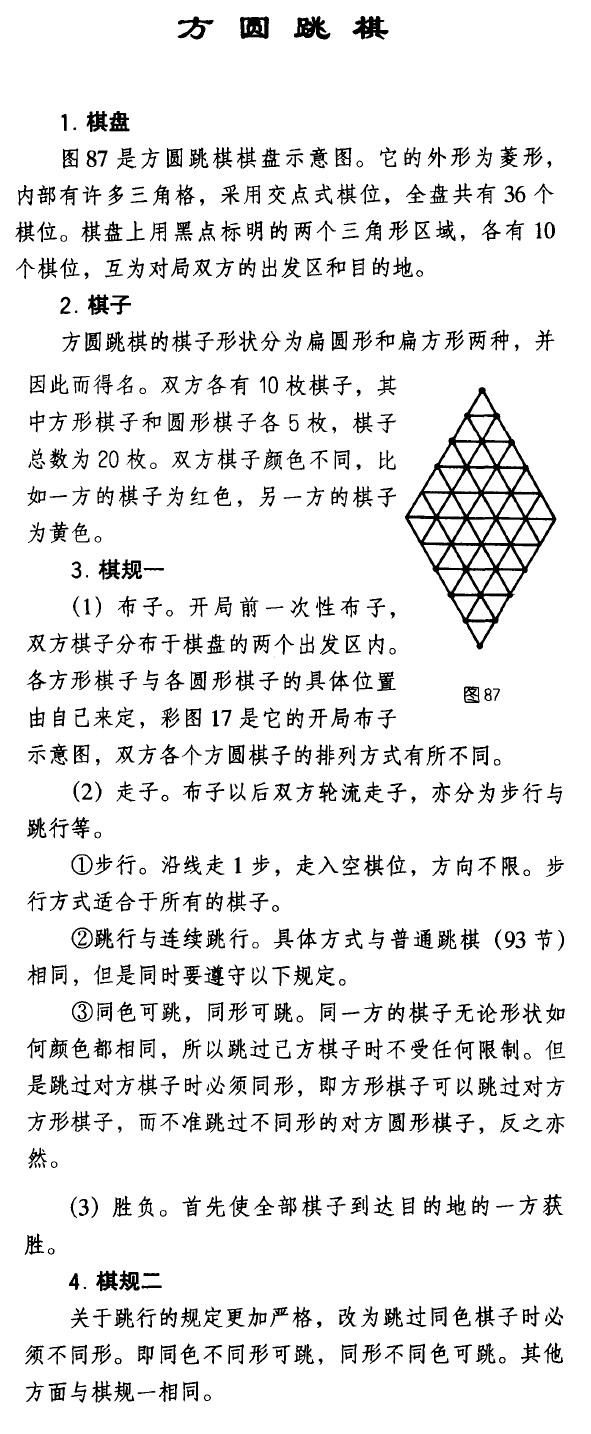
Square–Circle Jump Chess (方圆跳棋)
1. Board

Figure 87 shows the board for Square–Circle Jump Chess.
The board has a diamond-shaped outline with many small triangular cells inside,
and uses intersection points as playing positions.
There are 36 positions in total.

Two triangular regions on the board are marked in black. Each region contains
10 positions and serves respectively as the starting area and the goal area for
the two opposing players.

2. Pieces

The pieces in Square–Circle Jump Chess come in two shapes: oval (round) and
rectangular (square)—hence the name of the game.

Each player has 10 pieces: 5 square pieces and 5 round pieces, for a total
of 20 pieces.

The two players’ pieces are distinguished by different colors; for example,
one player may use red pieces and the other yellow pieces.

3. Rules I

(1) Initial placement

Before the game begins, pieces are placed once at the start.
Each player places their pieces within their own starting area.
The exact positions of the square and round pieces are determined freely
by the player.

Figure 17 shows an example of the initial setup; the two players’
arrangements may differ.

(2) Movement

After setup, players take turns moving. There are two types of movement:
step moves and jump moves.

① Step move

Move along a line by one step into an adjacent empty position.
Direction is unrestricted.
Step moves may be used by all pieces.

② Jump moves and consecutive jumps

The detailed rules are the same as in standard Jump Chess,
but the following additional rules apply.

③ Jumping rules by color and shape

Pieces of the same color may always be jumped over, regardless of shape.

When jumping over an opponent’s piece, the shapes must be the same.

For example, a square piece may jump over an opposing square piece,

but may not jump over an opposing round piece; and vice versa.

(3) Victory

The first player to move all of their pieces into the goal area wins.

4. Rules II (Variant)

The jumping rules are made stricter:

Jumping over a piece of the same color requires the shape to be different.

Jumping over a piece of the same shape requires the color to be different.

All other rules are the same as in Rules I.
This is a Halma-like game with two piece types and interact in different ways.
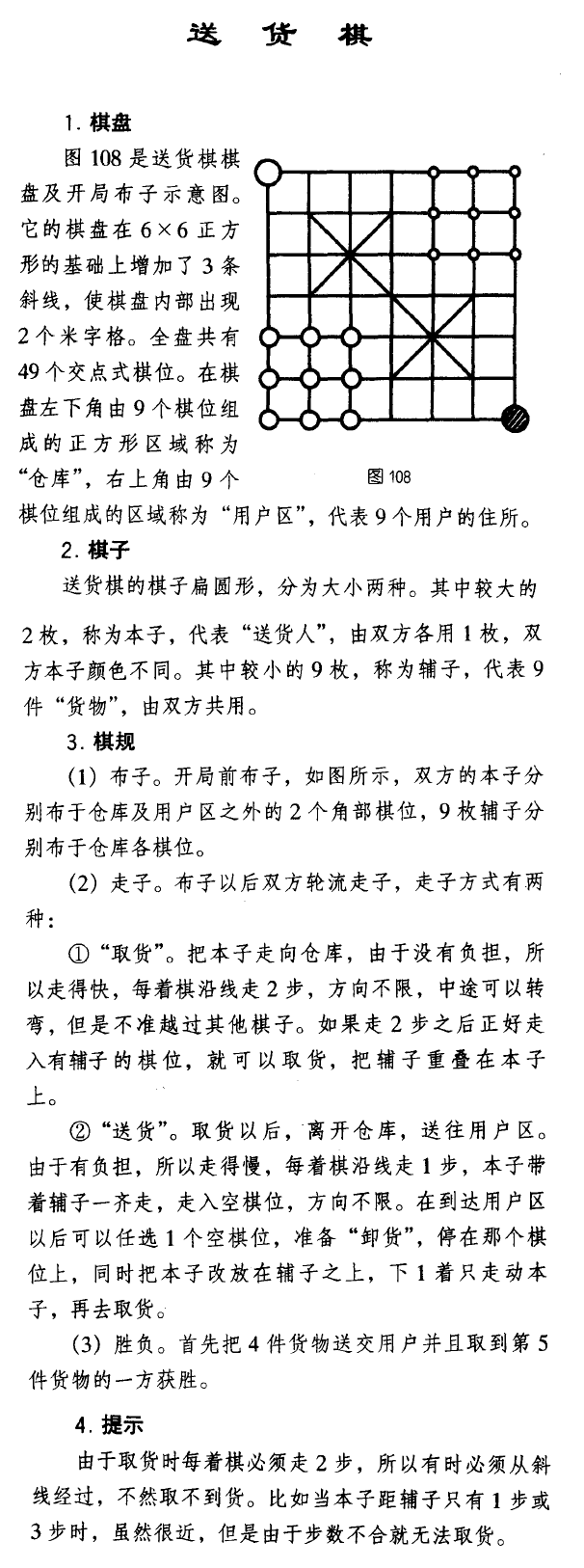
Delivery Chess (送货棋)

1. Board

Figure 108 shows the board for Delivery Chess and the initial setup.

The board is based on a 6×6 square grid, with three diagonal lines added,
forming two “rice-shaped” (×-shaped) grids inside the board.
The board uses intersection points as playing positions, with a total of 49 positions.

The lower-left corner of the board contains a square region of 9 positions,
called the “Warehouse”.

The upper-right corner contains another region of 9 positions, called the
“User Area”, representing the residences of 9 users.

2. Pieces

The pieces are oval-shaped and come in two sizes.

The two larger pieces are called main pieces, representing delivery workers.
Each player has one main piece, and the two main pieces are distinguished by color.

The nine smaller pieces are called auxiliary pieces, representing goods. These are
shared by both players.

3. Rules
(1) Initial placement

Before the game begins, pieces are placed as shown in the diagram.

Each player places their main piece on one of the two corner positions outside
the Warehouse and User Area.

The nine auxiliary pieces are placed on the nine positions within the Warehouse.

(2) Movement

After setup, players take turns. There are two types of moves:

① “Picking up goods”
The player moves their main piece toward the Warehouse.
Since the piece is not carrying a load, it moves quickly: 2 steps per turn, moving
along lines. Direction is unrestricted, and turns are allowed, but jumping over
other pieces is not permitted.

If, after moving exactly 2 steps, the main piece lands on a position occupied by
an auxiliary piece, the player may pick up the goods by stacking the auxiliary
piece on top of the main piece.

② “Delivering goods”
After picking up goods, the main piece leaves the Warehouse and moves toward the
User Area.

Because it is carrying a load, it moves slowly: 1 step per turn, along lines, into
empty positions only. Direction is unrestricted.

Upon reaching the User Area, the player may choose any empty position there to
prepare for unloading, stopping on that position and placing the main piece beneath
the auxiliary piece.

On the player’s next turn, only the main piece moves, heading back to pick up more goods.

(3) Victory

The first player to deliver 4 goods to users and then successfully pick up the 5th good
wins the game.

4. Hint

Because picking up goods requires exactly 2 steps per turn, players may sometimes need
to move along diagonal lines. Otherwise, it may be impossible to reach the goods.

For example, if a main piece is 1 step or 3 steps away from an auxiliary piece, it may
appear close enough, but since the number of steps is incorrect, the goods cannot be
picked up.