KING'S MEN
Copyright (c) 1937 Elizabeth Magie Phillips
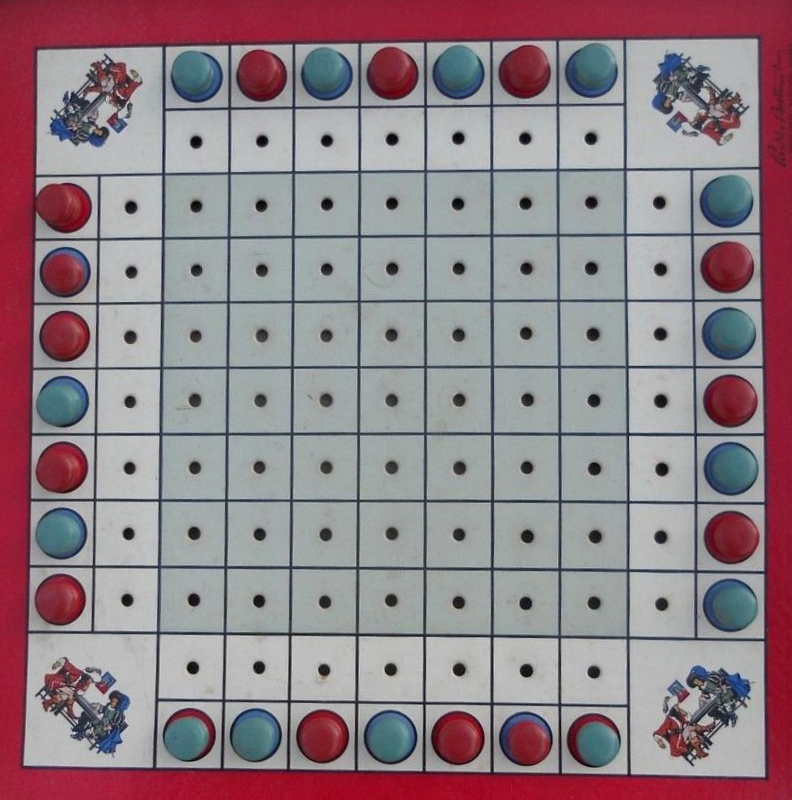
This game is played on the following board:
|
| An example Red's turn. The stone at g6 jumps over green's g7 landing on [1]. The jump is valid because there are at least on in-a-row made (in fact, there are a 3 in-a-row and a 4 in-a-row). All red stones not belonging to the extremes of any red in-a-row (the two marked stones) can be removed from board. Also, the jumped green stone must restart at a green lodge. |
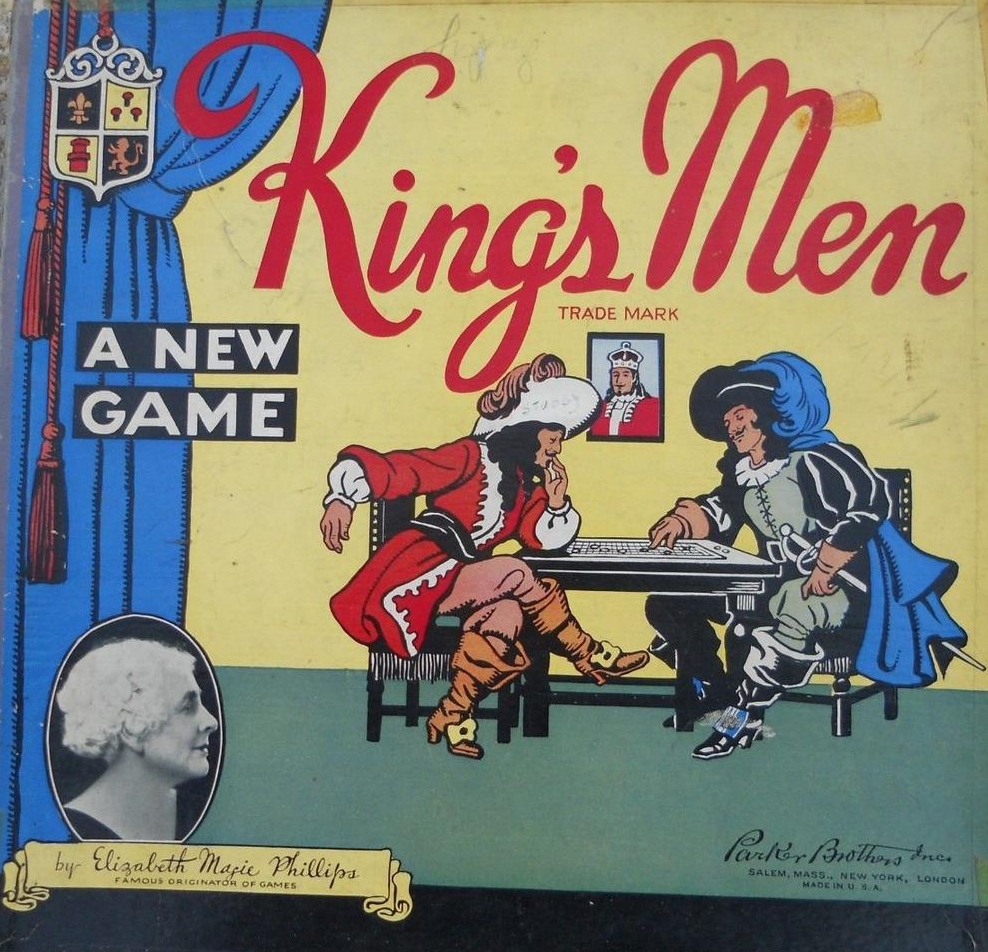
Here are some pictures I found about the Parker Brothers 1937 edition:
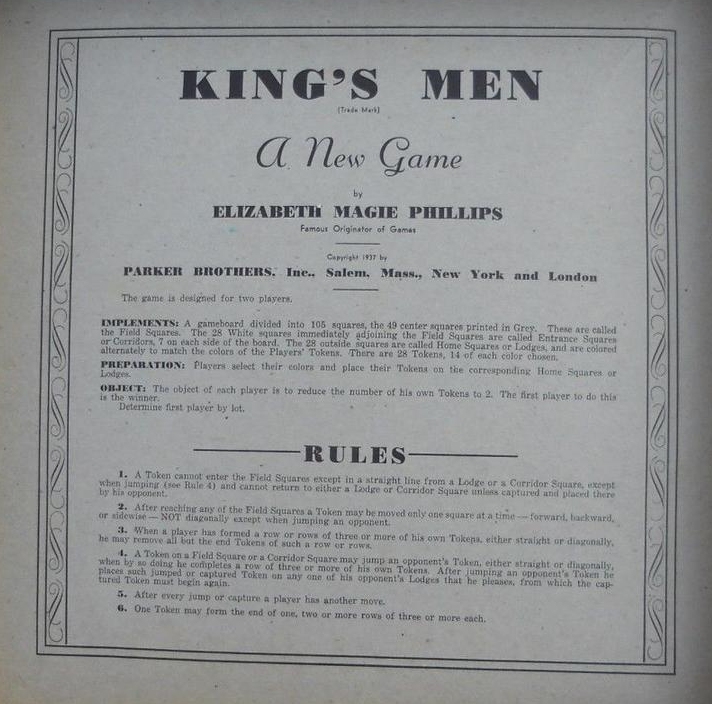
The rule's transcription, from http://abstractstrategy.com/kingsmen-rules.html,
King's Men is a game for 2 players created by Elizabeth Magie Phillips.
Implements: A gameboard divided into 105 squares, the 49 center squares printed in grey. These are called the Field Squares. The 28 white squares immediately adjoining the field squares are called Entrance Squares or Corridors, 7 on each side of the board. The 28 outside squares are called Home Squares or Lodges, and are colored alternately to match the colors of the Players' Tokens. There are 28 Tokens, 14 of each color chosen.
Preparation: Players select their colors and place their Tokens on the corresponding Home Squares or Lodges.
Object: The object of each player is to reduce the number of his/her own Tokens to 2. The first player to do this is the winner. Determine first player by lot.
Rules:
1) A Token cannot enter the Field Squares except in a straight line from a Lodge or a Corridor Square, except when jumping (see Rule 4) and cannot return to either a Lodge or Corridor Square unless captured and placed there by his/her opponent.
2) After reaching any of the Field Squares a Token may be moved only one square at a time—forward, backward, or sidewise—not diagonally except when jumping an opponent.
3) When a player has formed a row or rows of three or more of his/her own Tokens, either straight or diagonally, he/she may remove all but the end Tokens of such a row or rows.
4) A Token on a Field Square or a Corridor Square may jump an opponent's Token, either straight or diagonally, when by so doing he/she completes a row of three or more of his/her own Tokens. After jumping an opponent's Token he/she places such jumped or captured Token on any one of his/her opponent's Lodges that he/she pleases, from which the captured Token must begin again.
5) After every jump or capture a player has another move.
6) One Token may form the end of one, two, or more rows of three or more each.