 |
MOVEMENT - All stones move one cell orthogonal and diagonal forward: |
|
CAPTURE - Stones capture diagonal forward. Captures are not mandatory! |
|
GOAL - Wins the player who reaches the last rank with one stone. |
Copyright (c) 2000 W. D. Troyka
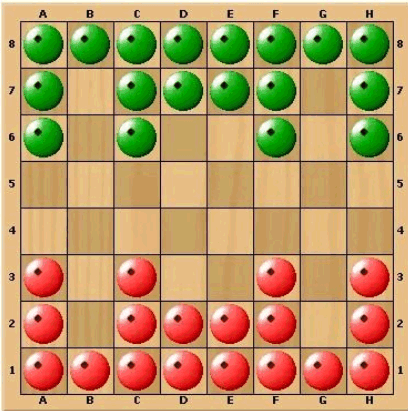
Breakthrough is a two player game played on a NxN square board. These are the three configurations proposed by W. Troyka.
|
Some playing tips are given by the author: This diagonal motion allows you to 'skirt' by an opponent piece by facing it head on, where it cannot capture you, and then moving diagonally around it. As a result, a single piece cannot by itself prevent an opponent piece from 'breaking through' the ranks. When pieces are spaced out along diagonals, an opponent piece can easily skirt through them. Look for weak links in your opponent's defenses where a single piece to the rear is guarding two attack routes.
There is a ZRF to play Breakthrough with Zillions.
A side note: I left the Zillions engine compute, for some time, the 5x5 setup. After more than 130 million positions analyzed, it could not give me a solution for the game!
| An example
Black can win in 3 moves. Can you find it? Solution: b3-b2! c1:b2 c3:b2 and win in one move |
Breakthrough was the winner of the 8x8 Game Design Competition, held in 2000/1. More details can be found on Abstract Games Magazine 7. It can be argued that the game is better in the original, smaller, boards. An 8x8 board delays piece iteration unnecessarily without providing any visible advantage.
A hexagonal variant from the same author is Sidewinder where stones may slide forward any number of empty cells.
Other related games are Sortie and Bombardment.Also check the page of Pawnographic Chess for a bit more history regarding this ludeme.
A 2020 variant is Baroj,
Pieces move 1 or 2 cells forward orthogonally and diagonally, (sideways and backwards moves are not allowed) and captures are made by jumping in straight line over an adjacent friendly piece and falling on an adjacent enemy piece. Captures can be made in any of 4 orthogonal directions (so backwards and sideways captures are allowed, but not diagonally).
The goal of the game is to move one of your pieces out of the board through your opponent's line. Notice that pieces can move 2 cells forward, so you can move out of the board from your opponent's second row.
Dualthru is another variant, from 2013, by Matteo Perlini. The game is played in a 8x8 board, each player has 16 pieces that start in the respective first two rows:
Objective. The objective is to reach the opposite row with two of the player's Pawn. A player can win also when the other players has no enough moves to finish his turn.
Turns. White plays first, making one move. After this move players take turns making two moves each turn.
Plain move. A Pawn can be moved one cell straight or diagonally forward if the destination cell is empty.
Capture. A Pawn can move into a cell that is occupied by an opponent's Pawn if and only if that cell is one step diagonally forward. The opponent's Pawn is removed and the player's piece replaces it.
Movement restriction. If a Pawn, after an one-step move, ends in a cell under immediate attack of an opponent's Pawn – that is diagonally forward adjacent to an opponent's piece – that piece cannot make a second move in that turn.
Stampede is a 2026 game by Mike Zapala with the following rules:
The game is played on a 9x9 square board. Initially, each player puts 1 piece on each square in the three row closest to them (so 27 pieces total).
A turn consists of moving a single piece. If more than one piece occupies the same square, they are stacked in a column, and only the piece on top can move. Pieces move a single square forward, orthogonally or diagonally. If a target square already contains another pieces, land on top of them. If on your initial move you land on top of another piece, make a second move (edit: in case this wasn't clear, with any of your pieces) before ending your turn; you cannot skip the second move, nor can you make a third or subsequent move, even if you land on yet another piece.
You win if your piece reaches the enemy's backrank.Author notes: I think the fact that pieces don't get captured, just temporarily 'jailed', adds the kind of flavor you don't often see. The 9x9 board might be a bit inconvenient, but it basically guarantees that P2 will be the first to 'jail' an opponent, hopefully balancing stuff a bit; I have a feeling 7x7 might be too small. If 9x9 turns out too lengthy, I migh use 7x9. A special rule was needed to ensure that P2 doesn't win through simple mirroring: I initially toyed with limiting the stack height to 3, but I feel like the double step rule adds some extra tactical 'oomf'.
